
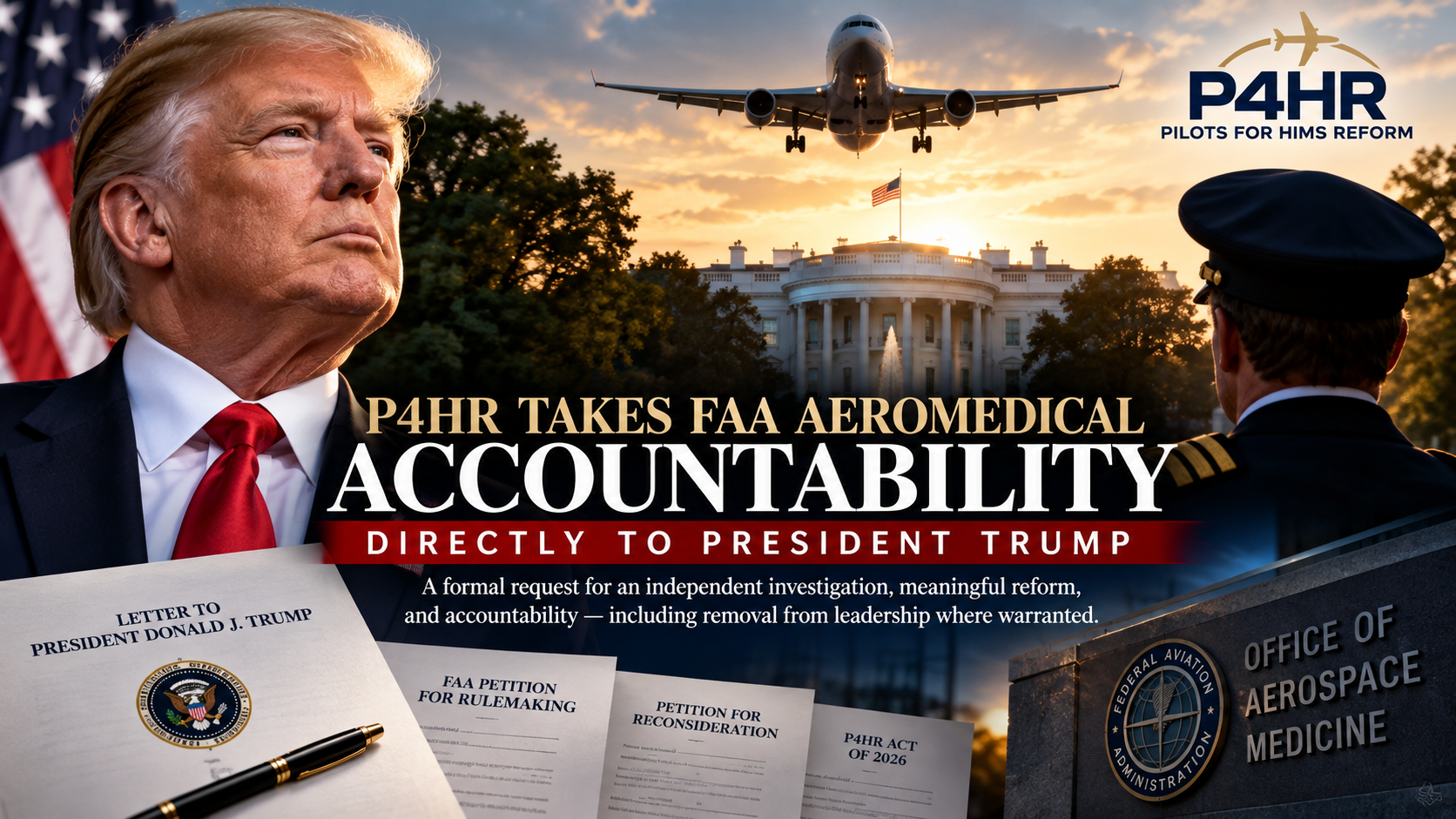
P4HR Takes FAA Aeromedical Accountability Directly to President Trump
After the FAA rejected P4HR's comprehensive rulemaking petition, the coalition has taken its concerns directly to the White House—asking President Donald J. Trump to examine aeromedical leadership, investigate accountability failures, and support structural reform.
President Donald J. Trump's older brother, Fred Trump Jr., was an airline pilot who struggled with alcoholism. That history makes the issue before the President unusually personal.
If Fred had survived, achieved recovery, and sought to continue flying today, the FAA aeromedical system P4HR is challenging is the system that would decide whether he could continue his career, how long federal monitoring could continue, what conditions could be imposed, and whether years of demonstrated recovery would ever be enough for unrestricted medical certification.
On October 28, 2026, Pilots for HIMS Reform formally submitted its concerns to the White House and directed President Trump and his staff to a full signed letter and supporting public record.
The central request: examine the system, examine its leadership, and determine whether extraordinary federal aeromedical power is being exercised with sufficient science, transparency, consistency, due process, and accountability.
Why P4HR Went to the White House
P4HR has spent 2026 pursuing reform through the formal channels available to aviation professionals and advocacy organizations.
On August 19, P4HR filed a comprehensive Petition for Rulemaking under 14 C.F.R. Part 11. The FAA assigned the matter Docket No. FAA-2026-10399. The petition proposed reforms to Special Issuance certification, HIMS monitoring, substance-related and psychiatric review, testing, independent medical evaluation, written reasons for consequential decisions, objective progression and completion criteria, procedural safeguards, and pathways to unrestricted certification when continued restrictions are no longer justified by current individualized risk.
The petition was not an all-or-nothing demand. P4HR expressly asked the FAA to consider narrower, severable reforms even if the complete package could not move forward immediately.
On October 8, the FAA denied the petition.
The agency cited broad considerations such as priorities and available resources, but the written decision did not meaningfully identify why the substantive reforms were rejected or why narrower alternatives—such as written explanations and objective monitoring criteria—were not pursued.
On October 14, P4HR filed a formal Petition for Reconsideration under 14 C.F.R. § 11.101. That filing asks the FAA to withdraw the denial, reconsider the petition in whole or in severable part, or at minimum provide a petition-specific explanation for its decision.
That request remains pending.
The Problem Is Bigger Than Rulemaking
The dispute now reaches beyond the language of regulations.
The Office of Aerospace Medicine exercises extraordinary authority over the careers of American pilots. In Special Issuance and HIMS cases, that authority can involve recurring laboratory testing, specialist evaluations, records demands, monitoring requirements, step-down decisions, restrictions, and determinations concerning whether extraordinary oversight will continue.
P4HR's position is straightforward: when the federal government makes a medical decision capable of controlling an American citizen's profession, it should be able to identify the evidence, identify the standard, explain the safety rationale, and provide meaningful review.
Where objective medical evidence supports progression, completion, or unrestricted certification but the FAA reaches a contrary conclusion, pilots should not be left guessing why.
What evidence controlled the decision? What standard was applied? What would satisfy the agency? And who independently reviews the answer when the officials whose decisions are being challenged remain inside the same chain of command?
P4HR Asks for Independent Scrutiny of Aeromedical Leadership
The letter specifically asks the Administration to examine leadership and decision-making involving Federal Air Surgeon Dr. Susan Northrup, Deputy Federal Air Surgeon Dr. Brett Wyrick, and other officials involved in disputed aeromedical decisions, including Dr. Matthew Dumstorf.
P4HR is not asserting that improper motive has already been proven. The organization is asking for independent review of whether affected cases reveal bias, retaliation, abuse of discretion, improper personalization of medical decision-making, disregard of material scientific evidence, or leadership failures.
That distinction matters. Allegations should be investigated, not presumed. But independent review becomes especially important when questions involve officials within the same leadership structure responsible for administering the disputed system.
P4HR's letter asks that where misconduct, retaliation, abuse of discretion, disregard of scientific evidence, or leadership failure is established, responsible officials be held accountable—including removal from leadership where warranted.
One Pilot's Case Illustrates the Larger Question
P4HR co-founder Captain Maurice MacEwen's certification history is cited in the letter as one example of why independent review is warranted.
MacEwen has approximately nine years of documented sobriety, years of negative testing, favorable medical and psychological evidence, ongoing monitoring compliance, and continued safe operation as an airline captain under a First-Class Special Issuance medical certificate.
He also received direct communication from Dr. Wyrick concerning anticipated progression through FAA monitoring. After discussions involving Wyrick and Northrup, MacEwen moved into a reduced monitoring phase. Wyrick later communicated his intent that MacEwen would progress to unrestricted certification after one year in that advanced program.
That anticipated progression did not occur.
No relapse has been identified. No positive alcohol or drug test has been cited. No new deterioration in medical status has been explained.
P4HR's concern is therefore not merely that the result was unfavorable. It is that the objective medical or safety basis for changing the anticipated progression has not been meaningfully explained.
An unfavorable medical decision can still be legitimate. But if the government cannot explain the evidence and standard that drove it, the issue becomes one of accountability as well as medicine.
Why Fred Trump Jr. Matters to This Conversation
P4HR invokes Fred Trump Jr. carefully and deliberately.
President Trump has spoken publicly for years about his brother's struggle with alcohol and the profound effect that experience had on him. Fred was also a professional pilot.
Modern addiction medicine, recovery science, psychiatric treatment, testing, and individualized risk assessment have advanced dramatically since Fred's lifetime. P4HR believes federal aeromedical policy should advance with them.
If an airline pilot recognizes a problem, gets treatment, demonstrates recovery, satisfies legitimate safety requirements, and establishes through objective evidence that he or she is medically fit, recovery should mean something.
If the government believes extraordinary restrictions should continue, it should be prepared to explain why.
The Pilots Carrying the President's Family Live Under This System
There is another connection P4HR placed directly before the President.
In his professional capacity as an airline captain, MacEwen has served as captain on flights carrying several members of the Trump family. The letter makes clear that this is not offered as a claim to special treatment or special access.
It illustrates a larger point.
The pilots entrusted to carry the President's family, members of his Administration, and millions of American families every day are subject to the same federal aeromedical system P4HR is asking the Administration to examine.
Those pilots accept rigorous medical standards. They accept extraordinary professional responsibility. They accept that aviation safety comes first.
What they should not have to accept is unexplained government decision-making or indefinite medical restrictions without sufficiently identifiable standards, endpoints, and accountability.
Rulemaking, Legislation, and Accountability
The White House letter makes clear that P4HR's work is not limited to the pending Part 11 petition.
P4HR has also developed the proposed Pilots for HIMS Reform Act of 2026. The rulemaking petition asks the FAA to implement reforms within its existing authority. The proposed Act addresses broader statutory protections, independent oversight, procedural safeguards, medical independence, scientific integrity, transparency, and enforceable accountability.
The White House request adds a third component: examination of the leadership and culture responsible for administering the existing system.
What P4HR Asked President Trump to Do
P4HR's signed letter asks the President and appropriate members of his Administration to:
- Review FAA Docket No. FAA-2026-10399, including the October 8 denial and P4HR's pending Petition for Reconsideration.
- Review the proposed Pilots for HIMS Reform Act of 2026 and the need for independent statutory oversight.
- Direct independent examination of FAA aeromedical leadership, culture, and decision-making.
- Determine whether consequential aeromedical decisions are based on current objective evidence and identifiable standards.
- Examine whether pilots who criticize HIMS or FAA aeromedical policy have experienced retaliation, bias, disparate treatment, or improper medical characterization.
- Require meaningful personnel accountability where misconduct or leadership failure is established—including removal where warranted.
- Meet with P4HR so affected aviation professionals, documentary evidence, proposed reforms, and scientific materials can be presented directly.
This Is an Accountability Question
P4HR is not asking political officials to substitute political judgment for medical judgment.
It is asking that medical decisions actually be medical decisions—supported by current evidence, identifiable standards, individualized risk, legitimate clinical judgment, and established science.
Criticism of a government program should not become a medical symptom. Advocacy for reform should not become evidence of disease. Disagreement with a federal official should not determine whether someone remains under extraordinary medical restrictions.
Aviation safety and accountable government are not competing principles. They should reinforce one another.
Your brother was an airline pilot. The pilots carrying your family today live under this system.
P4HR believes President Trump is uniquely positioned to understand why getting this right matters.
Aviation safety demands rigorous standards. American government demands accountability.
Extraordinary governmental power requires extraordinary accountability.
Research, rulemaking, legislative advocacy, federal oversight work, communications, travel, and technical review all require resources. If you believe FAA aeromedical power must be transparent, scientific, and accountable, please support the work.
Support P4HR