
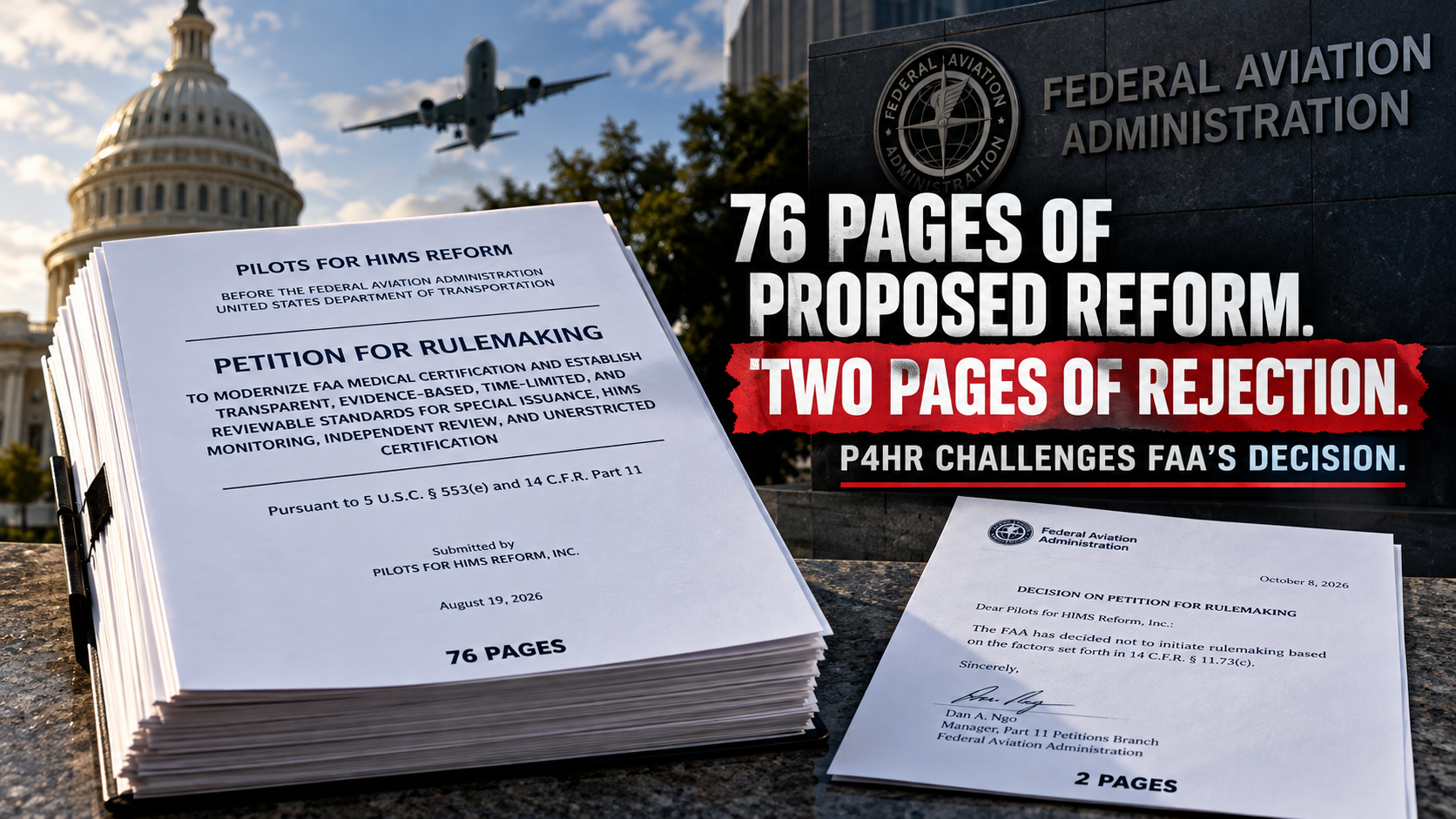
76 Pages of Proposed Aviation Medical Reform. Two Pages of Rejection. P4HR Challenges FAA's Decision.
FAA declines to initiate HIMS and medical certification rulemaking without addressing the petition's substantive proposals in its decision letter. Pilots for HIMS Reform files formal reconsideration and requests a meaningful explanation.
On August 19, 2026, Pilots for HIMS Reform (P4HR) submitted a 76-page petition asking the Federal Aviation Administration to modernize the rules governing medical certification, Special Issuance, and the Human Intervention Motivation Study (HIMS) monitoring system. It offered proposed regulatory language, scientific authorities, legal analysis, and narrower alternatives if the FAA would not pursue the entire package.
Fifty days later, on October 8, the FAA denied the petition in a two-page letter. It cited general rulemaking priorities and resources, but did not explain which particular safety, priority, or resource considerations justified rejecting P4HR's proposals.
On October 14, P4HR filed a formal Petition for Reconsideration under 14 CFR § 11.101. The coalition is asking the FAA to revisit the denial, explain its decision, and consider the narrower rulemaking options the original petition expressly offered.
The central question: If the FAA will not pursue transparent, evidence-based standards for its aeromedical certification system, will it at least explain why?
The FAA offered a conclusion—not a petition-specific explanation
The October 8 letter, signed by Dan A. Ngo, Manager of the FAA's Part 11 Petitions Branch, cites the three considerations in 14 CFR § 11.73: the immediacy of safety or security concerns, competing agency priorities, and available resources. It then states that P4HR's petition does not meet the criteria for rulemaking at this time.
The letter does not identify which factor controlled the decision. Did FAA consider the safety issues insufficiently urgent? Did it conclude that another specific rulemaking project took priority? Was the proposal too resource-intensive? Could a narrower set of rules have been considered? The written denial does not answer those questions.
The agency stated that P4HR's arguments would be "placed in a database" for possible consideration during future rulemaking and that it would take no further action on this petition.
Under 14 CFR § 11.73, the FAA has considerable discretion to prioritize regulatory projects, including declining petitions based on urgency, priorities, and resources. P4HR does not dispute that authority. It disputes whether the letter adequately explains how the FAA applied it to this petition.
The National Academies already recommended Part 67 modernization
In 2023, the National Academies of Sciences, Engineering, and Medicine published Substance Misuse Programs in Commercial Aviation: Safety First. Among its recommendations was revising FAA medical-certification regulations—especially 14 CFR Part 67—to better align with evidence-based diagnostic approaches, illness severity, and individualized care.
P4HR's petition proposed revisions to precisely those regulations. It sought to distinguish a clinically diagnosed substance-use disorder from an isolated event or historical label; to recognize severity and remission where appropriate; and to separate diagnosis from present aeromedical risk. The petition also preserved FAA authority to deny or restrict medical certification when current evidence establishes a genuine safety concern.
The FAA's written denial did not discuss the National Academies' recommendation. That omission does not prove the report was never considered internally. It does underscore why P4HR has asked for a meaningful explanation of the agency's decision.
Federal HIMS oversight is already underway
On March 19, 2026, the Department of Transportation Office of Inspector General announced an audit of FAA oversight of HIMS. An audit is not a finding of wrongdoing; it is an independent oversight inquiry into a program of substantial importance to aviation professionals and public safety.
P4HR proposed reforms to clinical governance, independent review, transparency, consistency, and monitoring accountability. Its original petition asked the agency to consider those issues alongside the ongoing oversight review. The FAA's decision letter does not explain whether the audit or its subject matter affected the rulemaking assessment.
This was not an all-or-nothing request
Perhaps the most consequential unanswered point concerns the petition's expressly severable alternatives. In Sections IV.D and XIII.A, P4HR acknowledged that some proposals could require extensive rulemaking, additional evidence, or legislation. It asked the FAA to pursue independently authorized components even if the complete package could not proceed.
Those more targeted proposals included written reasons for adverse medical decisions, access to the material decisional record, objective HIMS step-down and completion standards, reasonable decision deadlines, and transparent evaluator qualifications.
The FAA's denial does not describe an assessment of those narrower options. A comprehensive overhaul may require substantial administrative effort; a focused rulemaking on written decisions or monitoring exit criteria presents a different feasibility question. P4HR's reconsideration asks the FAA to address that distinction.
A September 30 FAA guidance update makes the question more immediate
Eight days before the denial, the FAA updated its Substance Use Disorders disposition table. For certain pilots previously subject to Special Issuance or Special Consideration, the table directs an aviation medical examiner to ISSUE a certificate when specified conditions are met, including appropriate FAA documentation that current and ongoing monitoring is not required and no new concerning events.
The pathway was not created for the first time in September 2026, nor does the table independently authorize AMEs to end a monitoring requirement. Still, the guidance confirms that FAA policy contemplates circumstances in which ongoing monitoring is unnecessary.
P4HR's petition asks the FAA to establish objective, transparent, evidence-based, and reviewable standards for reaching that decision. The October 8 denial does not explain why formal regulatory consideration of those standards is unwarranted.
The consequences are measured in careers, years, and personal lives
Medical certification can determine whether a pilot is able to fly, earn a living, or continue a career. HIMS requirements may involve recurring testing, expensive specialists, periodic evaluations, employer and peer reporting, and years of monitoring.
P4HR's petition documents concerns about prolonged monitoring, uncertain exit criteria, inconsistent administration, administrative delays, and a lack of meaningful review when a pilot is refused progression or unrestricted certification.
None of the proposed safeguards would require certification of an unsafe pilot. The petition expressly preserves immediate protective action when reliable, individualized medical evidence demonstrates material aviation-safety risk.
The central principle is simple: necessary restrictions should be medically supported, clearly explained, proportionate to present risk, and subject to meaningful review.
P4HR formally challenges the denial
P4HR submitted its Petition for Reconsideration on October 14, 2026, invoking 14 CFR § 11.101. The filing challenges the adequacy of the FAA's explanation, emphasizes the failure to address severable regulatory options in the written decision, and requests consideration of subsequent developments.
It also asks whether the FAA received and considered P4HR's October 2 supplemental submission describing additional medical and scientific advisory resources. The absence of a reference to that supplement in the denial does not establish that it was ignored; P4HR is asking the agency to confirm how it was handled.
The coalition requested preservation and voluntary disclosure of appropriate nonprivileged decision-making records. A separate Freedom of Information Act request is another available avenue for obtaining releasable agency documents, but is distinct from the reconsideration process.
Reconsideration does not guarantee that the FAA will reverse course. It is a formal means to seek review of qualifying errors and to ask the agency for a reasoned response.
Aviation safety and procedural accountability belong together
The FAA's duty to protect the flying public is not in dispute. What P4HR challenges is the idea that transparent rules, timely decisions, independent medical review, and meaningful monitoring completion standards are somehow at odds with that duty.
A system that encourages early treatment, recognizes recovery and present medical evidence, and provides clear pathways to completion can strengthen—not weaken—aviation safety.
The National Academies recommended modernization. Federal oversight is underway. P4HR submitted specific regulatory language and narrower alternatives. The FAA declined to initiate rulemaking without explaining its treatment of those substantive proposals in the denial letter.
Seventy-six pages of proposed reform received two pages of rejection. P4HR has asked the FAA to reconsider—and to explain its decision.
Recovery deserves recognition. Safety deserves science. Federal regulatory decisions deserve accountability.