
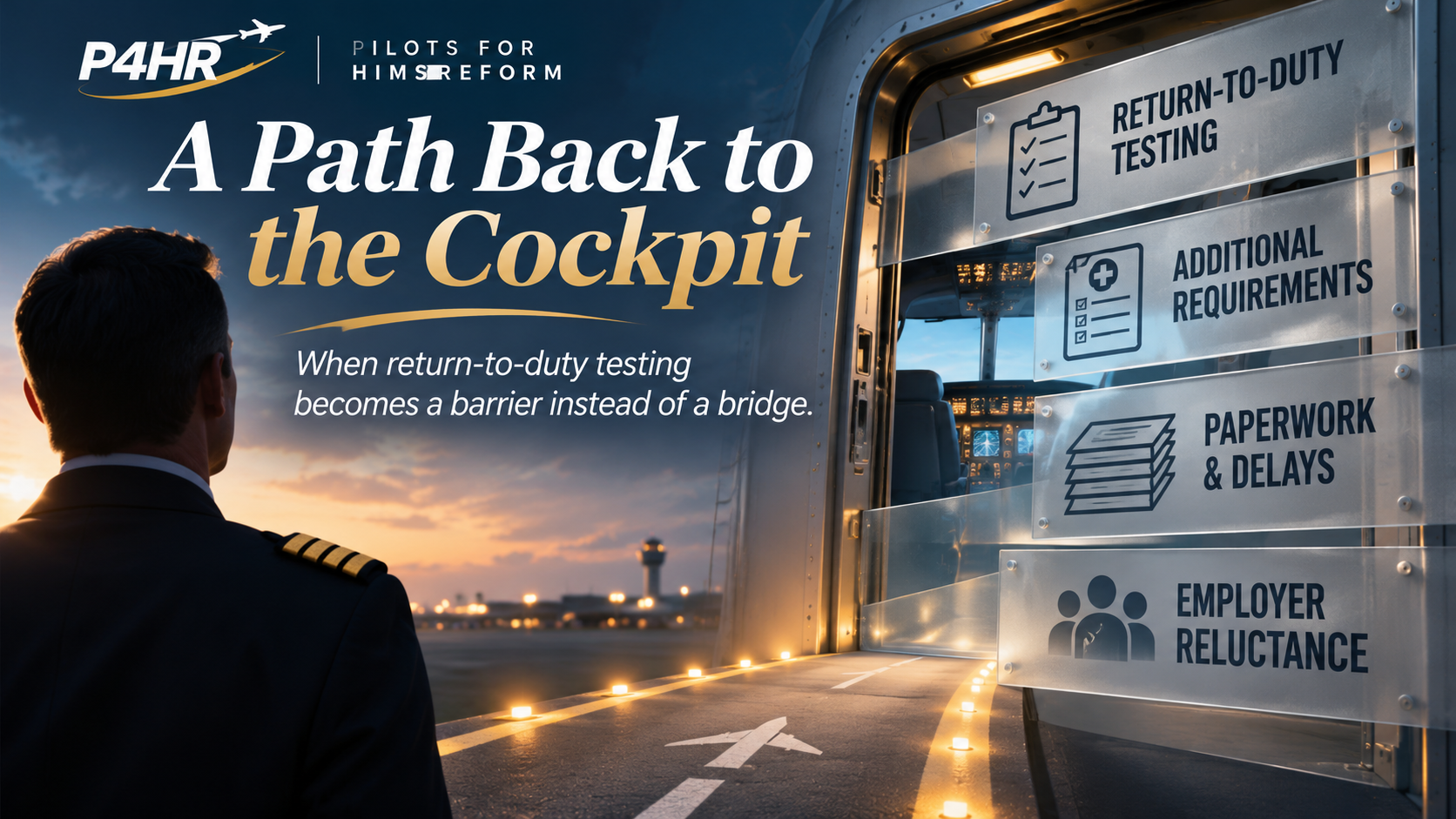
A Path Back to the Cockpit—If Someone Will Open the Door
How federal return-to-duty rules may be trapping pilots between completed rehabilitation, employer reluctance, and an uncertain future.
A pilot makes a mistake. A Department of Transportation drug or alcohol violation follows. Federal regulations remove that individual from safety-sensitive duty, require professional evaluation, and establish a process involving education or treatment, additional testing, and continuing oversight before returning to work.
That is how the system is supposed to function.
But what happens when a pilot attempts to follow the required process, only to discover that no employer is willing to administer the testing needed to get back to work?
For at least one aviation professional whose situation was recently brought to the attention of Pilots for HIMS Reform (P4HR), that question is no longer hypothetical.
According to an account shared with our organization, a pilot attempting to return to aviation following a DOT testing violation has encountered repeated difficulty finding an employer willing to facilitate the required return-to-duty testing.
The individual is described as wanting to return to flying but unable to secure the employer participation necessary to complete the process. P4HR has not independently reviewed the pilot's entire Substance Abuse Professional (SAP) record, FAA medical certification status, or employment applications. We are withholding identifying details to protect the individual's privacy.
The situation nevertheless raises a substantial policy question:
Has the federal government created a pathway to rehabilitation that can become practically inaccessible to people who no longer have an employer?
The Rules Provide a Path Back. Employers Control the Final Step.
Under 49 CFR Part 40, Subpart O, a person who violates DOT drug or alcohol regulations cannot simply resume safety-sensitive work.
The individual must undergo an evaluation by a qualified SAP, successfully comply with the prescribed education or treatment, and undergo a follow-up evaluation.
Before returning to safety-sensitive duties, the individual must receive a qualifying negative return-to-duty drug test or an alcohol test showing a concentration below 0.02, as applicable.
Once work resumes, federal regulations require at least six unannounced follow-up tests during the first 12 months of safety-sensitive duty. Additional testing may continue for up to 60 months, as determined by the SAP.
These are significant obligations intended to protect the public.
But 49 CFR § 40.305 contains a crucial provision: the decision to return someone to a safety-sensitive position remains with the employer. Completion of the rehabilitation requirements does not compel an employer to offer employment.
The FAA made the same distinction in its September 2024 aviation drug-and-alcohol testing newsletter.
In a section addressing second-chance policies, the agency explained that employers choose whether to provide another employment opportunity. In the following section, it confirmed that the employer offering work must conduct the required return-to-duty testing and implement subsequent follow-up testing.
Read the FAA's September 2024 newsletter, especially pages 3–4.
That creates a consequential dependency. An individual can pursue the treatment requirements independently, but the final testing obligation under the ordinary FAA employment pathway depends on an employer willing to assume responsibility.
If no employer is willing to participate, how does the individual complete the process?
A Regulatory Catch-22
Consider the predicament faced by someone who has lost employment following a DOT violation.
The individual may obtain a SAP evaluation, attend treatment or education, and complete the SAP's requirements. They may spend substantial personal resources attempting to satisfy those conditions.
But their former employer may have no interest in reinstatement.
A prospective employer, meanwhile, must assess not only the candidate's qualifications but also the administrative and compliance responsibilities associated with return-to-duty and follow-up testing.
Under 49 CFR § 40.309, the employer must implement the SAP's testing requirements, schedule unannounced tests, maintain appropriate records, and ensure compliance.
These obligations are manageable under a properly administered testing program. However, they introduce responsibilities that some employers may be reluctant to undertake.
An employer may decide that hiring another qualified applicant presents fewer administrative complications. Another may have a zero-tolerance policy. A third may simply be unfamiliar with how to handle an applicant who has undergone rehabilitation following a DOT violation.
We do not yet have reliable industry-wide evidence establishing how frequently these decisions occur or how many qualified applicants remain unable to complete the process.
But the regulatory structure creates the possibility of a troubling outcome:
The person needs an employer to complete the return-to-duty process, while employers may reject the person because that process remains incomplete.
That is a problem deserving serious examination.
Accountability Should Not Mean Permanent Exclusion
P4HR is not suggesting that a positive DOT test should be ignored.
Pilots operate in one of the most safety-sensitive professions in the world. Passengers and fellow crew members deserve rigorous safeguards against impairment.
DOT drug and alcohol testing requirements exist for legitimate public-safety reasons.
Nor is every violation eligible for the same return-to-duty pathway. Certain violations can carry additional FAA consequences, including circumstances in which returning to aviation is not legally available.
Furthermore, a pilot who is required to hold an FAA medical certificate must satisfy applicable aeromedical requirements independently of the DOT return-to-duty testing process.
These protections cannot be bypassed.
But where federal regulations expressly allow an individual to pursue rehabilitation and return to safety-sensitive employment, the process should offer a meaningful opportunity to do so.
Otherwise, a system presented as rehabilitation may operate, in practice, as indefinite professional exclusion.
There is a fundamental difference between someone who refuses to comply with safety requirements and someone who is attempting to comply but cannot secure the participation needed to finish.
A functioning regulatory system should recognize that distinction.
Other Transportation Workers Have a Limited Alternative
A particularly revealing comparison exists within another DOT-regulated industry.
The Federal Motor Carrier Safety Administration (FMCSA) recognizes circumstances in which a commercial driver seeking to complete return-to-duty requirements has no current or prospective employer.
According to the agency's official Drug and Alcohol Clearinghouse guidance, such a driver may register as an owner-operator and designate a consortium or third-party administrator for the limited purpose of completing the return-to-duty process.
The designated administrator can direct the required test and report its negative result.
FMCSA: Return-to-Duty Guidance for Drivers Without Employers.
This is a specific accommodation within the motor-carrier regulatory framework. It does not automatically apply to FAA-regulated pilots.
But it establishes something important.
Federal regulators have already recognized, in another transportation sector, that the absence of an employer can interfere with completing return-to-duty requirements.
Why should aviation regulators not examine whether a comparable, properly supervised mechanism is appropriate for eligible aviation professionals?
P4HR has not identified an equivalent generally available employer-free pathway in the FAA's published return-to-duty guidance.
If such a lawful option exists, the FAA should identify it clearly. If it does not, policymakers should examine whether one can be established without compromising aviation safety.
Is This Discrimination?
This question deserves careful legal consideration.
Federal DOT regulations do not require employers to rehire individuals after testing violations. Employers retain discretion over employment decisions, subject to other applicable laws.
However, that discretion is not necessarily unlimited.
Guidance from the Equal Employment Opportunity Commission explains that individuals who have successfully completed rehabilitation and are no longer engaging in illegal drug use may qualify for protection under the Americans with Disabilities Act.
The ADA does not protect current illegal drug use when an employer acts on that basis. It also permits appropriate safety and qualification standards.
A past positive DOT test, standing alone, does not automatically establish an ADA-protected disability or prove unlawful discrimination.
Nevertheless, employers should understand the distinction between a documented, individualized safety concern and an employment decision based solely on assumptions about a person's history.
A blanket unwillingness to consider rehabilitated applicants deserves scrutiny, particularly when the underlying federal regulations establish a process intended to allow eligible individuals to return.
Whether any specific employer has violated the ADA would require examination of the individual's circumstances, qualifications, applicable regulations, and the employer's reasons for rejection.
P4HR is not making that accusation against any particular company.
We are questioning whether the current framework produces preventable barriers that undermine its stated rehabilitative purpose.
What P4HR Is Calling For
Pilots for HIMS Reform believes the FAA and DOT should examine this issue directly.
Five initial actions
- Clarify the pathway. Publish clear guidance explaining exactly how an unemployed aviation professional who has satisfied SAP education and treatment requirements can complete the remaining return-to-duty steps.
- Evaluate independent testing administration. Examine whether qualified, regulated third-party administrators could facilitate return-to-duty testing for eligible aviation applicants without a current employer, while preserving employer responsibilities once safety-sensitive duties begin.
- Improve employer guidance. Provide practical compliance procedures for employers considering candidates with completed SAP requirements, including conditional hiring processes, record transfers, testing obligations, and continuing oversight.
- Measure outcomes. Collect anonymized information on the number of individuals who complete SAP education or treatment but are unable to secure employment and finish return-to-duty testing.
- Examine discrimination and access barriers. Determine whether existing employer practices create unnecessary obstacles for otherwise qualified applicants and whether additional guidance or safeguards are needed.
None of these proposals requires the FAA to abandon rigorous testing, certification, or public-safety standards.
They require the government to examine whether its own rules deliver the opportunity for rehabilitation that they appear to promise.
An Invitation to Aviation Employers
P4HR is asking aviation employers, charter operators, aviation human-resources professionals, DOT program administrators, and qualified SAPs to help us better understand this problem.
We are particularly interested in hearing from FAA-regulated employers who have successfully returned an individual to safety-sensitive duties after a DOT violation.
What procedures did you follow? What costs or administrative challenges did you encounter? What would make the process easier without reducing safety?
We also want to hear from employers willing to consider qualified applicants who are eligible to complete return-to-duty testing.
Our goal is to identify legitimate, compliant opportunities—not to circumvent federal regulations.
An Invitation to Pilots Who Have Been Turned Away
If you have completed the SAP process but cannot find an employer willing to administer return-to-duty testing, P4HR wants to understand your experience.
We are interested in the duration of your employment search, the obstacles you encountered, and whether employers have expressly cited DOT testing responsibilities as the reason for declining to proceed.
We also welcome accounts from pilots who successfully returned to duty.
Those experiences can help distinguish individual difficulties from broader structural problems.
Identities will not be published without permission. Participants may request anonymity and should avoid sending sensitive medical records in an initial email.
Share information with P4HR
Contact us at p4hr@pilotsforhimsreform.org. Include “Return-to-Duty Testing Experience” in your subject line.
Please do not include medical records, test results, or sensitive identifying details in your first message.
A Second Chance Must Be More Than a Regulatory Possibility
There is an important public-policy principle at stake.
A government that mandates rehabilitation should be willing to examine whether people who complete that rehabilitation can realistically access the process for returning to work.
For aviation, the objective must remain unchanged: qualified, medically eligible, unimpaired professionals operating aircraft safely.
But aviation safety and a functional rehabilitation pathway are not competing goals.
An effective system should be able to accomplish both.
When a person remains barred because of unresolved safety or qualification requirements, those requirements must be respected.
When the obstacle is instead the inability to find an employer willing to administer an otherwise permissible return-to-duty process, regulators should ask whether the system itself needs improvement.
The purpose of rehabilitation should be to create a verifiable path forward—not merely to describe one that nobody is willing to administer.
P4HR will continue examining this issue, collecting experiences, seeking responsible industry partners, and pursuing answers from the FAA and DOT.
Because a second chance that cannot be accessed is not much of a second chance.