
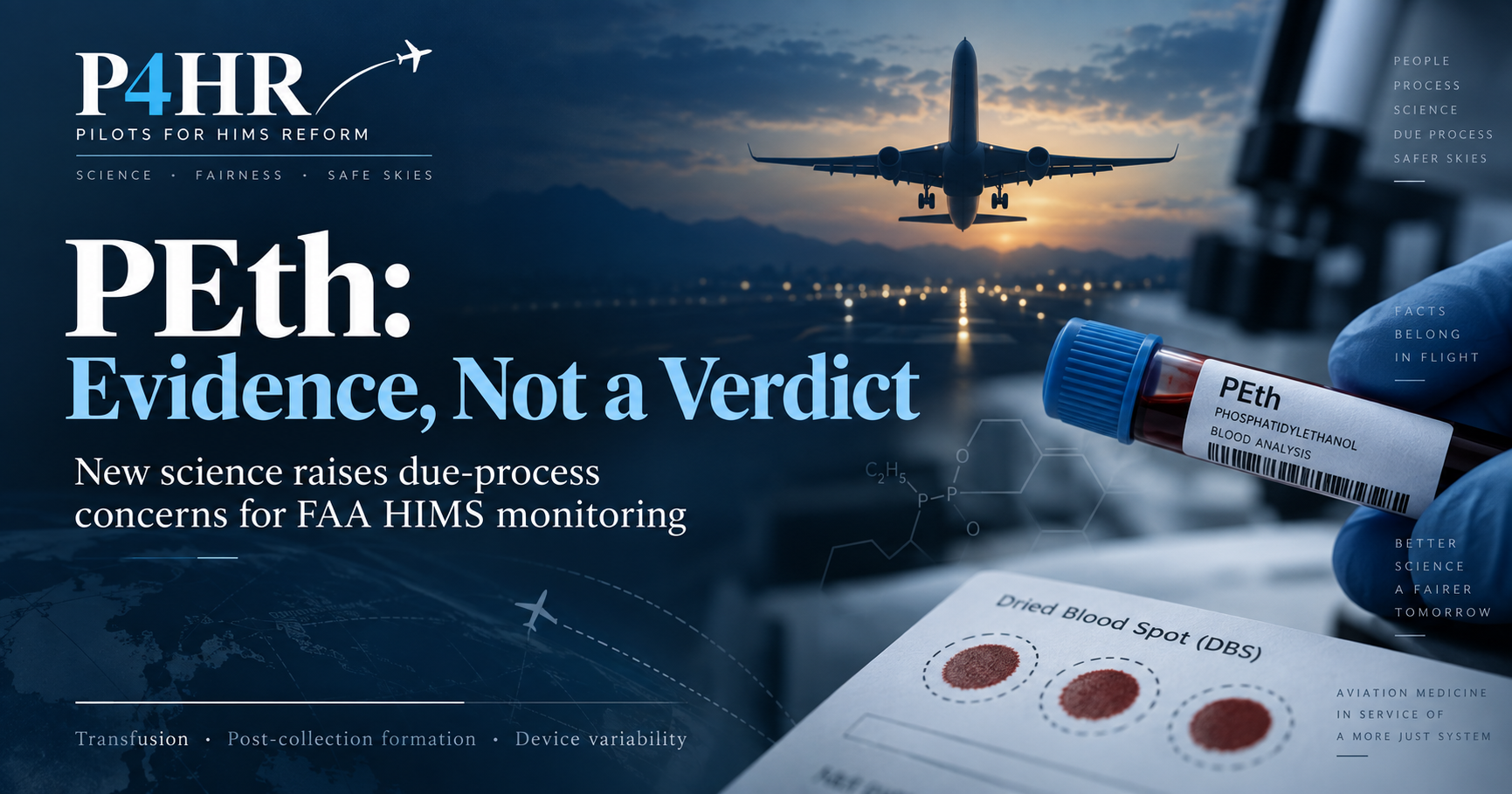
When a “Positive” PEth Does Not Prove Drinking
New science raises serious questions about how phosphatidylethanol results should be interpreted before FAA HIMS turns a laboratory number into a finding of alcohol use, relapse, or noncompliance.
For years, phosphatidylethanol—better known as PEth—has been promoted as one of the strongest objective biomarkers for detecting alcohol exposure. It is sensitive, it offers a longer detection window than many conventional alcohol biomarkers, and it can provide information that self-reporting cannot.
That does not make PEth infallible. And it does not justify treating every reported concentration above a decision threshold as a biochemical confession.
That distinction matters in ordinary clinical medicine. It matters even more in a safety-sensitive regulatory system such as FAA HIMS, where an adverse monitoring result can affect a pilot's medical certification, livelihood, reputation, and career.
The FAA uses PEth in a high-stakes monitoring system
The FAA's current Guide for Aviation Medical Examiners continues to direct pilots with certain drug- or alcohol-related diagnoses into evaluation and monitoring through the HIMS system. The published HIMS Step Down Plan states that permanent abstinence from mind- and mood-altering substances is required for the duration of the flying career and identifies four PEth tests in 12 months during Advanced Phase 3, covering years five through seven.
That makes PEth interpretation a due-process issue as well as a laboratory issue.
The simplistic chain is tempting:
The emerging science shows that the first arrow in that chain can fail.
First, define “false positive” correctly
The phrase false positive is often used too loosely in PEth disputes. There are at least three different problems that can produce a result that is misleading in a regulatory context.
- Analytical or pre-analytical artifact: the reported PEth concentration is affected by what happens to the specimen during or after collection.
- True PEth that did not come from the tested person's drinking: for example, PEth transferred in donated red blood cells.
- True PEth generated by non-beverage ethanol exposure: unusual environmental or occupational exposure can, in rare circumstances, cross a commonly used decision threshold.
In the latter two situations the laboratory may have correctly measured PEth. What can still be wrong is the conclusion: “Therefore, this person drank an alcoholic beverage.”
Blood transfusion can make an abstinent person PEth-positive
This is now established by multiple studies.
In a 2026 prospective study of 50 people receiving one unit of packed red blood cells, four patients—8%—changed from PEth-negative below 20 ng/mL to PEth-positive above 20 ng/mL after transfusion. Six patients had increases beyond the method's coefficient of variation, and the maximum increase was 51 ng/mL. The authors concluded that PEth should be interpreted cautiously following recent transfusion.
A separate single-unit transfusion study reported an even larger effect. Among recipients whose pre-transfusion PEth was below the laboratory's lower limit of quantitation and who received a PEth-positive red-cell unit, 19.6% subsequently measured at or above 20 ng/mL. The highest post-transfusion value in that group was 83.4 ng/mL.
Those findings defeat the proposition that every PEth concentration above 20 ng/mL necessarily reflects the recipient's alcohol consumption.
Transfusion-derived PEth can persist for weeks
A 2025 study of packed-red-cell recipients found that transfusion-derived PEth did not simply disappear overnight. Time to clearance below 10 ng/mL ranged from less than one day to more than 19 days. The authors recommended cautious interpretation for approximately two to three weeks after transfusion.
That creates an obvious due-process requirement for any monitoring program: before treating a PEth result as evidence of alcohol use, the reviewer should know whether the person received blood products during the relevant window.
PEth can form after the blood leaves the person's body
Another documented issue is post-sampling formation.
PEth is formed through phospholipase D activity in the presence of ethanol. A 2021 study demonstrated that in blood specimens containing ethanol, PEth formation can continue after sampling, producing falsely elevated concentrations. Researchers observed post-sampling formation in wet blood and in certain volumetric microsampling devices stored at room temperature. Addition of the phospholipase-D inhibitor sodium metavanadate eliminated that post-sampling formation under the studied conditions.
This is not a credibility dispute between a pilot and a monitoring authority. It is a specimen-integrity problem.
If a career-impacting decision depends on a PEth result, the collection system, specimen type, storage conditions, transport conditions, laboratory method, and safeguards against post-sampling formation become part of the evidentiary record.
New evidence: the collection device can materially change the number
A recent study compared PEth measurements from 100 blood samples using three commonly employed dried-blood-spot systems: Whatman filter paper, Mitra, and Capitainer B Vanadate.
The device mattered.
For PEth 16:0/18:1, percentage deviations ranged from -8% to +116%. For PEth 16:0/18:2, deviations ranged from -14% to +264%. The researchers concluded that device selection can influence results and can potentially affect interpretation of alcohol use versus abstinence.
That does not mean dried-blood-spot testing is unreliable. The authors specifically described DBS as a reliable methodology. It means a reported concentration is not entirely independent of the collection system used to obtain it.
That distinction becomes especially important when a result sits close to a regulatory decision limit.
Non-beverage ethanol exposure: rare, but not impossible
P4HR does not support replacing one oversimplification with another.
The evidence does not show that ordinary use of hand sanitizer routinely causes PEth-positive results above 20 ng/mL. Controlled studies have generally found that even intensive sanitizer use does not turn a PEth-negative individual into a positive one at that threshold.
But a study examining incidental ethanol exposures in people reporting 90 days of beverage-alcohol abstinence identified one credible participant with near-daily intensive ethanol-vapor exposure whose PEth reached 26 ng/mL. The authors concluded that unusual intensive incidental exposure can, under some circumstances, modestly exceed the 20 ng/mL threshold.
Importantly, the authors described PEth at or above 20 ng/mL as supporting a “rebuttable presumption” of beverage alcohol use.
That phrase matters. A rebuttable presumption is evidence that demands an explanation. It is not an irrebuttable verdict.
The 20 ng/mL threshold is a decision limit—not a law of biology
The commonly used 20 ng/mL threshold has substantial scientific support as a practical decision point. But its history also deserves precision.
A 2023 Clinical Chemistry analysis traced the scientific sources underlying common PEth cutoffs and reported that the authors could find no patient-based validation scientifically underpinning the most frequently cited original source for the U.S. 20 ng/mL cutoff. The same researchers then used a much larger abstinence dataset to provide considerably stronger empirical support for the cutoff after approximately four weeks of abstinence, finding high specificity under the conditions studied.
Those two facts can coexist.
The threshold is useful. It is scientifically defensible as a decision tool. But it is not a magical biological boundary at which uncertainty vanishes.
A PEth number cannot tell you exactly what happened
Modern PEth literature repeatedly emphasizes interindividual variability in formation and elimination. A concentration can be highly informative, but it does not reliably reveal the exact amount of alcohol consumed, the exact time it was consumed, or—in every possible scenario—the source of the ethanol exposure.
A 2026 review of PEth analysis highlights the importance of whole-blood preparation, LC-MS/MS methodology, stability, dried-blood-spot analysis, and other special analytical considerations. That is what one would expect of a sophisticated biomarker: its interpretation depends on methodology and context.
What FAA HIMS should require before declaring relapse
P4HR believes the FAA should adopt a formal PEth adverse-result review protocol before an isolated result is converted into a finding of beverage alcohol consumption, relapse, or noncompliance—particularly when the concentration is near a lower decision threshold or conflicts with the pilot's longitudinal record.
- Report the actual data. Identify the PEth homologue or homologues tested and the exact concentrations—not merely “positive.”
- Review recent transfusion history. Determine whether red-cell transfusion occurred during a scientifically relevant period.
- Document specimen type and collection device. Whole blood, DBS methodology, and the specific DBS system matter.
- Document safeguards against post-sampling formation. The testing record should show how the collection and storage method addressed this known phenomenon where applicable.
- Review handling, transport and chain of custody. High-stakes regulatory evidence deserves a complete specimen history.
- Account for method uncertainty. Analytical precision and uncertainty matter most near a consequential decision boundary.
- Consider hematocrit and relevant biological variables. These can affect interpretation and comparability in some settings.
- Evaluate credible non-beverage exposures. Do not accept implausible explanations, but do not prohibit scientifically recognized ones from being considered.
- Consider the longitudinal record. One anomalous result should be evaluated alongside years of prior testing and clinical evidence.
- Obtain prompt corroboration where appropriate. Repeat PEth testing and complementary biomarkers can help resolve a disputed result, while recognizing that no single biomarker is itself infallible.
Due process belongs in laboratory medicine too
When the government or a government-directed monitoring program uses a laboratory result to impose a potentially career-ending consequence, meaningful due process requires more than the opportunity to be told that the test was positive.
A pilot should have access to the information necessary to understand and challenge the inference being drawn: the numerical result, testing methodology, specimen type, collection device, chain of custody, laboratory uncertainty, relevant medical history, and the scientific basis for concluding that the result demonstrates beverage alcohol consumption.
If contemporary peer-reviewed science identifies recognized alternative explanations, those explanations must be capable of being investigated before punishment follows.
That is not an argument for ignoring positive PEth tests. It is an argument for adjudicating them instead of merely announcing them.
Safety-sensitive does not mean science-optional
The predictable response is that aviation is safety-sensitive and the FAA therefore must err on the side of caution.
P4HR agrees that aviation is safety-sensitive. That is precisely why the evidence should be handled correctly.
A safety-sensitive system should distinguish screening from adjudication. It should distinguish ethanol exposure from proven intentional beverage ingestion. It should distinguish an isolated low-level result from a sustained pattern. And it should distinguish a PEth value just above a decision threshold from a concentration hundreds of nanograms per milliliter higher.
Scientific caution cuts both ways. It means taking a credible positive result seriously. It also means refusing to claim the evidence proves more than the science permits.
P4HR's position
P4HR is not calling for abandonment of PEth testing. PEth is a valuable biomarker and can provide powerful evidence of ethanol exposure.
We are calling for the FAA and HIMS system to use PEth according to what modern science actually supports.
A positive result may provide strong evidence of beverage alcohol consumption. Depending on the magnitude, pattern, collection methodology, corroborating evidence and surrounding circumstances, it may provide very strong evidence.
But modern research now demonstrates circumstances in which the inference can be wrong.
No pilot should be declared to have relapsed solely because a laboratory value crossed a decision threshold without first determining whether the result actually proves what the monitoring authority says it proves.
That is not weakening aviation safety.
That is what evidence-based aviation medicine—and basic scientific due process—should look like.
Key scientific and regulatory sources
- Packed red blood cell transfusion affecting phosphatidylethanol concentration (2026) — prospective single-unit transfusion study; 8% crossed from below to above 20 ng/mL.
- Impact of a single packed red blood cell unit on recipient phosphatidylethanol (2026) — 19.6% of a defined pre-negative/PEth-positive-unit subgroup reached ≥20 ng/mL; maximum 83.4 ng/mL.
- Phosphatidylethanol clearance after packed red blood cell transfusion (2025) — transfusion-derived PEth persisted more than 19 days in some recipients; authors advised caution for 2–3 weeks.
- Measurement of PEth in dried blood spots and venous blood—importance of inhibition of post-sampling formation from ethanol (2021).
- Device does matter! Comparison of PEth concentrations from three dried blood spot sampling devices (2026).
- The effect of incidental ethanol exposures on the formation of blood PEth (2025).
- Increasing Confidence in a PEth 16:0/18:1 Cutoff at 20 ng/mL to Support Abstinence or Minor Intake of Alcohol (Clinical Chemistry, 2023).
- PEth in review: Phosphatidylethanol discovery and LC-MS/MS analysis (2026).
- FAA Guide for Aviation Medical Examiners — Drug and/or Alcohol Monitoring and HIMS Program.
- FAA Guide for Aviation Medical Examiners, current 2026 edition — includes the HIMS Step Down Plan identifying PEth testing in Advanced Phase 3.
About P4HR: Pilots for HIMS Reform is an independent pilot advocacy organization seeking transparent, evidence-based, time-limited and safety-focused reform of FAA HIMS medical certification and monitoring practices. P4HR is not affiliated with the FAA or the official HIMS Program.
Editorial note: This article is an advocacy and scientific-analysis piece, not individualized medical or legal advice. PEth results should be interpreted by qualified professionals in light of the complete clinical and analytical record.