
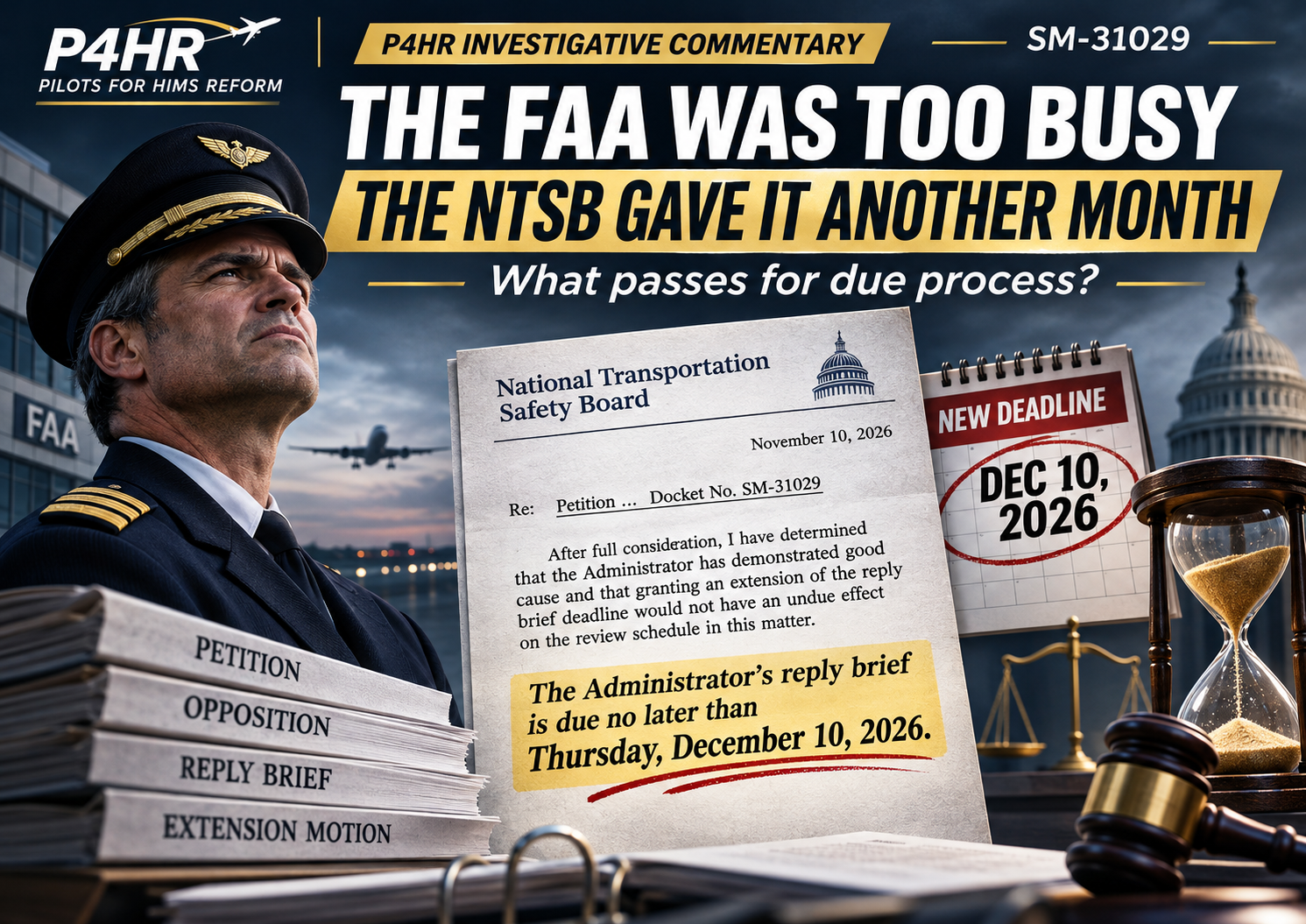
The FAA Was Too Busy. The NTSB Gave It Another Month. This Is What Passes for Due Process.
A federal agency asked for 36 more days because its attorney had other cases. The NTSB granted 28. Meanwhile, an airline captain's medical-certification appeal remains unresolved after a canceled merits hearing, disputed discovery, and more than nine years of documented abstinence.
By Captain Maurice MacEwen, Co-Founder, Pilots for HIMS Reform • Commentary and case analysis
On November 10, the National Transportation Safety Board informed the parties in Petition of Maurice MacEwen, Docket SM-31029, that the Federal Aviation Administration had demonstrated “good cause” to extend its reply-brief deadline. The FAA had requested 36 extra days, from November 12 to December 18. The NTSB granted 28 days, making its new deadline December 10, 2026.
What was the FAA's reason? Its attorney reported managing numerous other litigation matters and deadlines before the NTSB and in federal court. That was the substance of the November 6 motion. The motion did not identify particular conflicting dates or explain why another government attorney could not assist.
I opposed the request. My November 6 filing explained why another delay was not harmless to the pilot living under the restrictions being challenged and why an institutional workload assertion should not automatically satisfy the good-cause standard.
The NTSB's November 10 response acknowledged my opposition, concluded the FAA had shown good cause, and said the additional time would not appreciably affect its review schedule. The response did not provide a detailed answer to the specific prejudice arguments I raised.
We can call this routine scheduling. Or we can ask a more uncomfortable question: when one side is the federal government and the other is an individual whose livelihood depends on a medical certificate, whose time does the system actually value?
The FAA couldn't even correctly identify the certificate
The FAA's own November 6 motion described the proceeding as the denial of a private pilot certificate. That is wrong. The appeal concerns the denial of an unrestricted First-Class airman medical certificate—a critical credential for an airline captain. It is not the same thing as a private pilot certificate.
Does a caption mistake alone make the motion invalid? No. But when government counsel is requesting more time to handle a case, accurately identifying what the case is about should not be too much to expect.
They canceled the hearing before the evidence could be fully tested
This dispute began in November 2024. The case was stayed for a substantial period by agreement while settlement options were explored. Eventually an evidentiary hearing was scheduled for September 15–17, 2026. Instead, on September 28, Administrative Law Judge V. Stuart Couch granted the FAA summary judgment and affirmed the denial without holding that scheduled merits hearing.
His order recognized years of abstinence, sustained-remission diagnoses, favorable psychological testing, continuing recovery activity, monitoring compliance, and no identified relapse since October 2017. Those findings matter. But the judge concluded that the record contained no qualified medical opinion expressly establishing that the complete recovery standard for unrestricted certification had been met.
The FAA's Chief Psychiatrist, Dr. Chadwick Burgdorff, viewed disagreements with HIMS monitoring, requests to change evaluators, and objections to program administration as clinically significant evidence weighing against “satisfactory recovery.” Other clinicians had documented favorable recovery evidence, although some had also recommended continued monitoring. These competing interpretations deserved rigorous scrutiny.
My October 12 appeal to the full Board challenges the summary-judgment reasoning, the judge's treatment of previously identified medical witnesses, and the termination of the case while court-ordered discovery about the FAA's recovery criteria remained disputed. Those arguments remain undecided by the full Board.
Summary judgment is permitted by law. It is not automatically improper merely because the losing party wanted to testify. But the unresolved question here is whether contested medical interpretations and incomplete discovery were properly deemed immaterial before witnesses could be examined.
A system that can treat disagreement as medical evidence
I have not used alcohol or other prohibited substances since October 2017. I remain authorized to fly with a First-Class Special Issuance medical certificate and have documented compliance with FAA requirements. Indeed, a February 11, 2025 FAA memorandum signed by Aerospace Medical Certification Division Manager Dr. David O'Brien stated that I was in full compliance.
Yet in the litigation record, criticism of HIMS, friction with evaluators, and objections to monitoring have been characterized as clinically adverse. Legitimate behavioral evidence may matter in a medical evaluation. But disagreeing with the government is not, standing alone, a symptom of medical unfitness. When an agency uses a person's opposition to its program as part of its rationale, the reasons and factual foundation must be open to meaningful challenge.
There is an additional jurisdictional trap: the NTSB can review qualifying denials of unrestricted medical certification, but it generally cannot directly review the FAA's Special Issuance conditions or a decision about HIMS phase progression. A pilot can therefore remain caught between a restricted certification regime and a narrow avenue of administrative review.
How often do pilots actually win an NTSB appeal? Where are the answers?
Some pilots have repeated the claim that only six or seven percent of NTSB appeals succeed. We have not verified that figure. P4HR will not turn an unverified claim into a headline that the FAA wins 93 or 94 percent of cases. But the historical figures we can document raise serious questions about access, transparency, and outcomes.
Sources: AVweb's 2003 review of 2002 Board orders; NTSB 2025 Annual Report to Congress, p. 48; February 2026 NTSB OALJ presentation.
The NTSB's official 2025 annual report states that 284 cases were received and 295 closed, with 75 hearings scheduled and 16 held. These are aggregate administrative-law-judge figures encompassing more than medical cases; they are not a medical-appeal success percentage. A settlement may be favorable to either side. Nor are cases received, cases closed, and hearings scheduled identical cohorts.
A January 2005 U.S. Department of Transportation/Federal Railroad Administration study reported that in 2002 the NTSB considered 73 medical review applications; just one went to a hearing, while the rest were withdrawn or dismissed. That is a hearing-access statistic from 2002, not a pilot-loss rate. Still, it makes the need for modern, medical-specific disposition data impossible to ignore.
Read the 2005 DOT/FRA report, discussion of aviation medical appeals.
We should be able to answer a simple question: across the past decade, how many pilots challenging FAA medical denials obtained actual relief, how many received a merits hearing, how many cases ended procedurally, and how long did each path take? The publicly reported totals do not answer that question. P4HR intends to seek the underlying records rather than manufacture a percentage.
Medical appeals have literally been placed behind other cases
This is not merely an interpretation of a crowded docket. In Standing Order 25-1, effective May 5, 2025, the NTSB's Office of Administrative Law Judges directed that medical and nonemergency merits hearings would not be scheduled until further notice and after emergency appeals had been adjudicated, subject to a stated exception for extraordinary circumstances and due-process rights. The order explained staff shortages and elevated emergency workloads.
Priority for pilots already deprived of an immediately effective certificate has an understandable rationale. But pilots with medical denials also have careers and families. The order documented a conscious allocation of scarce adjudicative resources that left medical petitioners further down the line. It should not be mistaken for a permanent prohibition, and it does not by itself establish misconduct in any individual case.
When combined with today's extension ruling, the larger picture should concern anyone who believes access to meaningful review is a fundamental part of an accountable certification system.
Yes, I lost my temper
After the November 10 extension ruling, I sent an angry email to the NTSB and FAA counsel. I called the process a “farce” and a “sham.” I suggested they might as well rule against me immediately rather than keep going through the motions.
I am not proud of the tone. But I will not pretend the frustration was invented. Years of contested restrictions, the cancellation of a scheduled evidentiary hearing, disputed discovery, and now another accommodation for the government's schedule are not abstractions to the person living through them.
My angry email does not prove the NTSB is biased. And it does not erase the legitimacy of demanding an explanation. The government should be able to withstand forceful criticism from the people whose careers it regulates.
Civility is valuable. Silence is not a legal duty. And the expectation that pilots will politely absorb every procedural setback without challenging it must end.
What accountability would actually look like
P4HR advocates written, individualized medical rationales; transparent and scientifically defensible recovery criteria; timely decisions; proper discovery and witness examination when material facts are contested; an independent medical review mechanism; and protections for good-faith criticism of HIMS policies.
We also want publicly available annual outcome statistics, broken out by medical versus enforcement cases and by initial adjudication versus full-Board appeal. Count full relief, partial relief, remands, settlements, procedural dismissals and withdrawals separately. Without those distinctions, even a superficially precise “win rate” is meaningless.
A high government win rate, if one is eventually established, would not alone prove bias. The strength of cases, selection effects and burdens of proof matter. But a transparent, independent appeals system should be able to show the public how often it corrects an agency decision and how often applicants receive a meaningful hearing.
In the meantime the facts of this case remain: the FAA asked for 36 more days due principally to competing litigation commitments; the NTSB gave it 28; the case's original merits hearing never took place; and the full-Board appeal remains pending.
Due process must be more than an opportunity to file papers while the individual keeps waiting for government accountability. Pilots deserve a fair chance to test the evidence—not simply permission to keep appealing.