
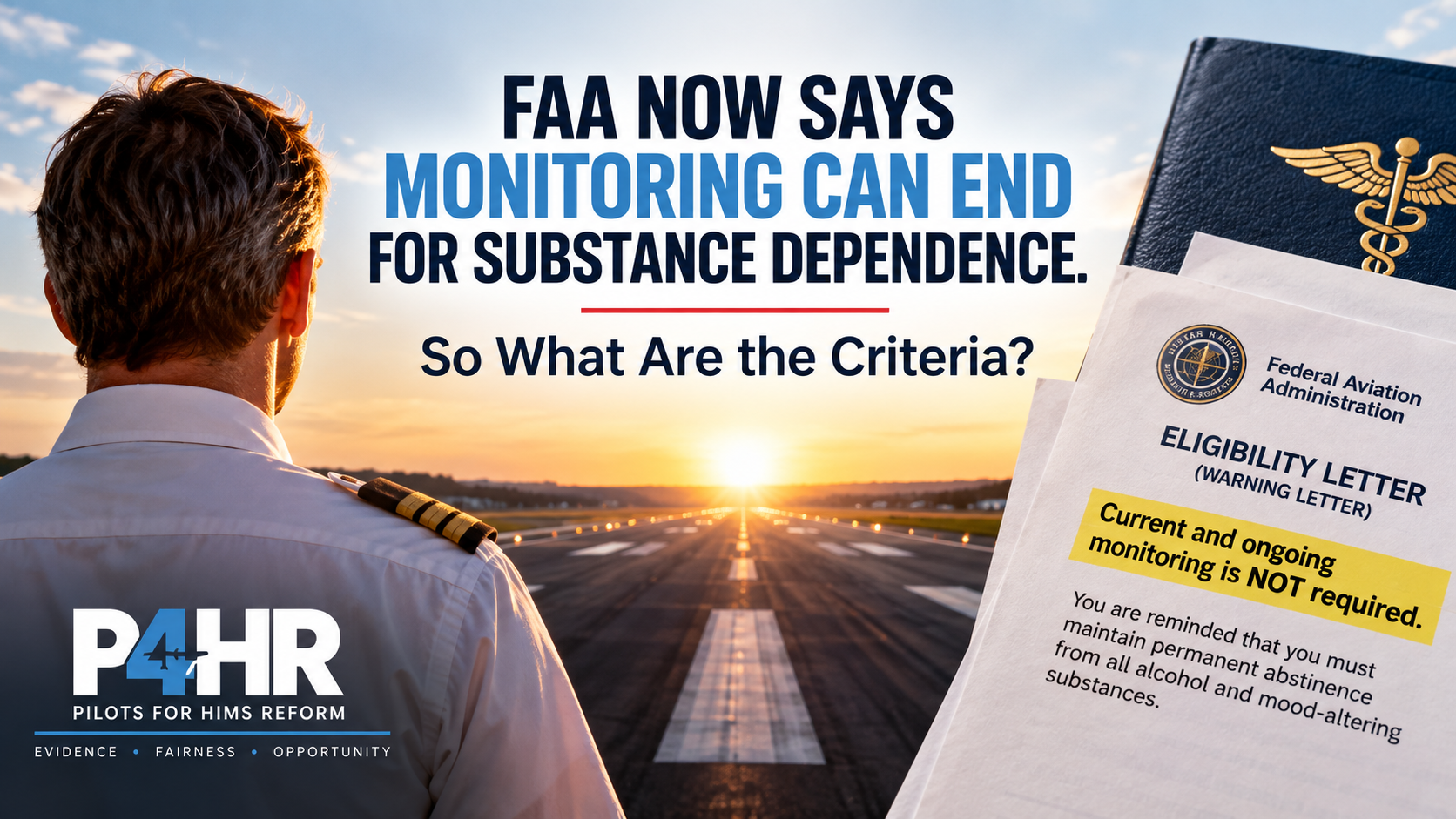
FAA Now Says Monitoring Can End for Substance Dependence. So What Are the Criteria?
A new FAA disposition table expressly recognizes pilots with a prior regulatory substance-dependence determination who were previously on Special Issuance but whom FAA has subsequently determined do not require current and ongoing monitoring. That makes one point clear: permanent abstinence does not necessarily mean permanent monitoring.
On September 30, 2026, the Federal Aviation Administration updated its Guide for Aviation Medical Examiners and added a dedicated disposition table for Substance Use Disorders (DSM); Substance Abuse or Substance Dependence (DSM or CFR).
For pilots who have lived for years under the assumption that an FAA determination of substance dependence necessarily means career-long Special Issuance oversight, one part of that table deserves particular attention.
The FAA now expressly addresses a pilot with a prior FAA regulatory determination of substance dependence who was previously on Special Issuance or Special Consideration. If the pilot has official FAA documentation stating that current and ongoing monitoring is not required, the FAA letter contains the permanent-abstinence warning, and there is no evidence or concern of relapse or a new substance-related event, the AME disposition is:
That instruction appears in FAA’s new Substance Use Disorders disposition table.
It is a significant statement of current FAA policy. In plain terms, permanent abstinence does not necessarily mean permanent FAA monitoring.
What actually changed on September 30?
The significance of the September 30 update is not that FAA suddenly discovered, for the first time, that monitoring can ever end. The history is more complicated.
An earlier FAA DUI/alcohol disposition table from 2017 covered both a history of alcohol-related events and alcohol dependence. Where the condition had previously been reported to FAA and the pilot possessed written FAA proof that monitoring was not required, the AME was instructed to issue. That table also contemplated continued abstinence after monitoring had ended. The archived FAA table remains available in the agency’s AME Guide history.
By the March 2026 AME Guide, pilots with a history of dependence or substance-use disorder were routed to FAA review and follow-up issuance under the terms of their authorization. The September 30 update reorganizes the policy and puts dependence into a dedicated SUD disposition table. The current DUI/DWI disposition table now directs applicable substance-dependence cases to the new SUD table.
So P4HR does not characterize September 30 as the invention of an entirely new legal authority. The more precise development is this:
FAA has now placed a no-monitoring pathway for regulatory substance dependence squarely into its current, condition-specific AME guidance.
There is no longer a need to infer that such pilots can exist. FAA’s own current table expressly tells AMEs how to certify them.
Recovery, abstinence, Special Issuance, and monitoring are different concepts
The governing medical standard is worth reading carefully. For a First-Class medical certificate, 14 C.F.R. § 67.107(a)(4) ordinarily disqualifies an applicant with an established medical history or clinical diagnosis of substance dependence. But the regulation contains an exception where there is established clinical evidence, satisfactory to the Federal Air Surgeon, of recovery, including at least the preceding two years of sustained total abstinence. Parallel provisions appear in the Second- and Third-Class standards.
That regulation does not say that every person who once met the regulatory definition of substance dependence must remain under testing, HIMS monitoring, or Special Issuance for the remainder of a flying career.
Special Issuance is a separate mechanism under 14 C.F.R. § 67.401. It permits discretionary certification subject to individualized conditions, evaluations, limitations, and renewal requirements.
The September 30 table makes the distinction unusually clear. A pilot’s FAA letter may still contain a permanent-abstinence warning while simultaneously stating that current and ongoing monitoring is no longer required.
FAA’s current guidance recognizes that the first can remain in place after the second ends.
Where does HIMS Phase 4 fit?
FAA’s existing HIMS Step Down Plan makes the unanswered question even more apparent.
The published HIMS AME Step Down Plan divides progression into four phases. Phase 1 begins with Special Issuance. Phase 2 covers the early years of monitoring. Phase 3 is the advanced step-down period. Maintenance Phase 4 begins at Year 8+.
FAA’s Step Down transition guidance and transition supplement describe prerequisites for moving into later phases. In general, progression to Phase 4 requires years of successful Special Issuance monitoring, successful time in the prior phase, continued compliance, demonstrated sobriety and recovery, and no concerning developments. FAA retains authority to deny or modify a proposed transition.
The pilot-facing Step Down Plan also states that permanent abstinence is required for the duration of the flying career and that decreases in monitoring remain subject to FAA determination.
What the public guidance does not clearly provide is a published bridge from Phase 4 to the September 30 no-monitoring disposition.
FAA has described how a pilot may progress to Maintenance Phase 4. The new SUD table describes what happens after FAA decides monitoring is no longer required. The missing piece is the standard connecting those two points.
So what are the criteria?
This is now the central policy question.
FAA has published meaningful prerequisites for step-down. It has now also published the AME disposition once FAA has decided continuing monitoring is unnecessary. But the public materials reviewed by P4HR do not identify an objective, transparent termination standard explaining when a pilot becomes eligible for that no-monitoring determination.
The governing regulation itself uses a highly discretionary formulation: recovery must be demonstrated through clinical evidence “satisfactory to the Federal Air Surgeon.”
Clinical judgment will always have a role in aeromedical certification. P4HR is not arguing otherwise. But clinical judgment is not the same thing as unpublished policy.
If some pilots with a prior regulatory determination of substance dependence can reach a point at which FAA concludes that current and ongoing monitoring is unnecessary, similarly situated pilots and their physicians should be able to understand the criteria the agency uses to make that determination.
What is an “Eligibility Letter” or “Warning Letter”?
The September 30 table provides useful clarification. FAA describes the required documentation as an official FAA letter to the individual, often referred to as an Eligibility Letter or Warning Letter. For regulatory substance dependence, the documentation must establish that ongoing monitoring is not required and include the permanent-abstinence warning.
This should not be confused with erasing the pilot’s medical history. FAA guidance continues to require accurate future reporting on MedXPress. FAA’s substance abuse and dependence FAQ explains the continuing reporting obligations for previously disclosed conditions.
In this context, the letter functions as FAA clearance from continuing monitoring for the previously adjudicated condition, while any continuing abstinence requirement remains in force.
This changes the “career-long monitoring” conversation
For years, FAA messaging has emphasized extended follow-up for pilots with substance dependence. The AME Guide explains that FAA extended follow-up under the HIMS Step Down Plan in response to NTSB safety recommendations. The underlying NTSB recommendations called for continuing oversight of clinically diagnosed pilots who were subsequently medically certified.
And in a 2024 FAA Safety Briefing, then-Federal Air Surgeon Dr. Susan Northrup wrote that where dependence is demonstrated, “years of monitoring is the rule.”
Years of monitoring, however, is not the same thing as monitoring forever.
The September 30 disposition table now expressly contemplates former Special Issuance pilots with regulatory substance dependence for whom FAA has determined that current and ongoing monitoring is no longer required.
For P4HR, that makes generalized claims that every pilot with a past dependence determination inherently requires lifelong aeromedical surveillance much harder to defend.
The diabetes parallel matters — but it is a parallel, not proof
There is also a broader policy development occurring inside FAA medical certification.
On September 4, 2026, FAA published a Notice of Proposed Rulemaking that would remove the automatic Special Issuance requirement for certain pilots with non-insulin-dependent diabetes mellitus. FAA’s rationale is that modern medical evidence and treatment have changed the risk picture and that unnecessary Special Issuance oversight can impose burdens without a corresponding safety benefit.
Substance dependence is medically and legally distinct, and the diabetes NPRM does not control HIMS certification. P4HR does not suggest otherwise.
But the governing principle is relevant:
Special Issuance should be a safety tool, not an institutional default that persists after the evidence supporting extraordinary oversight has disappeared.
FAA is currently willing to ask that question about diabetes. Its September 30 substance-use guidance shows that, at least for some pilots with past regulatory substance dependence, FAA has already acknowledged the same basic concept: there comes a point when continuing monitoring is not required.
What P4HR believes FAA should publish next
P4HR’s advocacy position follows from FAA’s own newly published framework.
The agency should explain how it determines that a pilot with prior regulatory substance dependence no longer requires current and ongoing monitoring.
That does not require promising every pilot release after a particular anniversary. Individualized medicine can coexist with objective standards.
FAA could publish the minimum prerequisites it considers, the factors that favor or disfavor termination, the role of the HIMS AME and addiction specialist, how many years of stable recovery ordinarily support consideration, whether time in Phase 4 is required, what testing history is expected, what circumstances justify extending monitoring beyond the ordinary period, and a defined process by which a pilot or HIMS AME can request the no-monitoring determination.
Most importantly, pilots should be told when they have become eligible for that review.
A system should not require someone to remain under extraordinary government medical oversight simply because neither the pilot nor the physician knows that there is a door out — or what must be shown to open it.
The question has changed
Until September 30, the public debate could too easily become an argument over whether FAA permits monitoring to terminate at all for someone it has previously determined to be substance dependent.
FAA’s current guidance largely resolves that question.
The more important question now is not whether the authority exists.
Who qualifies, when, and under what objective criteria?
P4HR believes the pilots subject to this system, the HIMS physicians responsible for administering it, and the public whose safety it exists to protect all deserve a transparent answer.
Because after September 30, one principle is no longer seriously debatable: permanent abstinence does not have to mean permanent monitoring.