
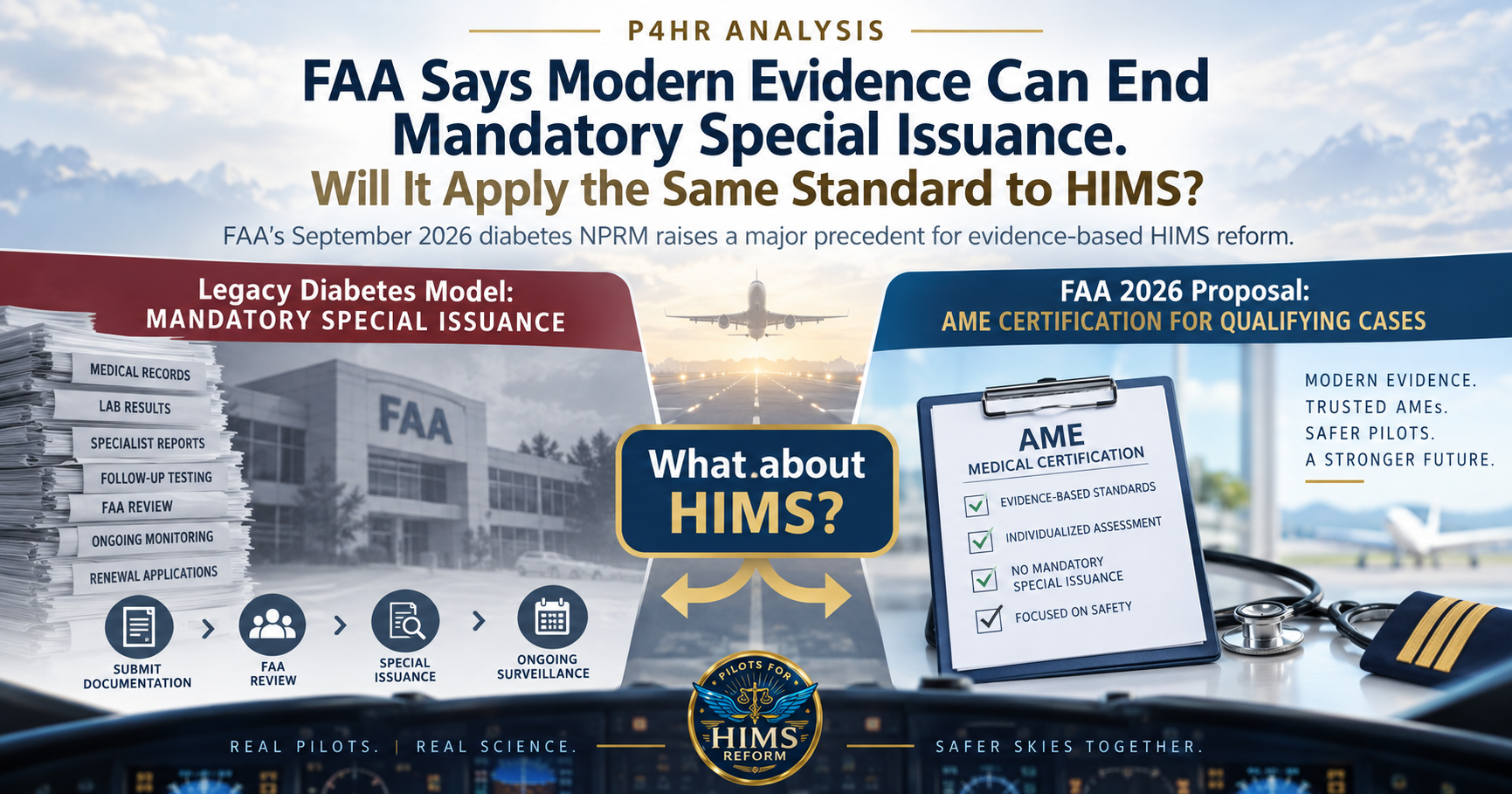
FAA Says Modern Evidence Can End Mandatory Special Issuance. Will It Apply the Same Standard to HIMS?
A new FAA diabetes rulemaking raises a question the agency can no longer easily avoid: when contemporary evidence undermines the assumptions behind a longstanding medical-certification burden, should that burden continue simply because it has become institutional practice?
On September 4, 2026, the Federal Aviation Administration published a Notice of Proposed Rulemaking titled Modernizing Medical Standards for Non-Insulin Dependent Diabetes Mellitus Cases, Docket FAA-2026-10990, Notice No. 26-15, RIN 2120-AM25. The proposal would amend 14 C.F.R. §§ 67.113(a), 67.213(a), and 67.313(a) so that applicants whose non-insulin-dependent diabetes mellitus is controlled with non-insulin medication would no longer automatically be forced through the § 67.401 Special Issuance process.
Instead, qualifying applicants could be evaluated by an Aviation Medical Examiner under the ordinary Part 67 standards and, when appropriate, receive a normal medical certificate at the time of examination. Higher-risk cases could still be denied or deferred for additional FAA review.
That change is important in its own right. For HIMS reform, however, the FAA's reasoning may be even more important than the diabetes rule itself.
FAA's own rationale: medicine changed, risk changed, so the process should change
The FAA says the existing diabetes language traces back to 1959, when the available treatments and risk profile were very different. The agency now says newer medication classes and modern disease management have substantially improved control and reduced severe complications. It therefore proposes removing non-insulin-dependent diabetes from the list of specifically disqualifying conditions that automatically require Special Issuance.
FAA also identifies the burden created by mandatory Special Issuance. According to the NPRM, routing all such cases through federal review increases waiting time, adds steps and personnel, consumes FAA medical resources, and contributes to backlogs. The agency says appropriate cases can instead be handled safely through individualized AME evaluation.
Most significantly, FAA did not rely on convenience alone. It reviewed fatal accidents involving pilots using non-insulin diabetes medications from 2008 through 2025. Of 51 identified cases, FAA concluded that diabetes, its complications, or its medications were an improbable contributor in 50; one remained under investigation. FAA then combined that safety review with contemporary medical evidence showing substantial reductions in serious diabetes complications.
Why the diabetes comparison matters to HIMS
The connection to HIMS is not something P4HR invented after the fact. Diabetes appears in the policy history used to justify extended monitoring of pilots with substance dependence.
In 2007, the National Transportation Safety Board issued Safety Recommendation A-07-43. In discussing Special Issuance, the NTSB contrasted substance dependence with other disqualifying chronic conditions and specifically listed myocardial infarction, insulin-treated diabetes, coronary heart disease, and epilepsy as examples in which pilots were followed under Special Issuance guidelines while they continued to hold such certificates.
The NTSB simultaneously acknowledged that Part 67 treated substance dependence differently: the regulation expressly allows certification without Special Issuance when the Federal Air Surgeon is satisfied that there is established clinical evidence of recovery, including at least two years of sustained total abstinence. Nevertheless, A-07-43 recommended continuing Special Issuance follow-up for pilots medically certified after a substance-dependence diagnosis.
FAA later implemented extended follow-up through the HIMS Step Down Plan. FAA's current AME Guide still states that the extended follow-up is in response to NTSB Safety Recommendation A-07-43.
An important distinction
P4HR is not claiming that the 2007 NTSB recommendation and the 2026 NPRM concern the identical diabetes population. They do not. A-07-43 used insulin-treated diabetes as one of several chronic-condition examples. The September 2026 NPRM concerns non-insulin-dependent diabetes treated with non-insulin medication, and the proposal would continue to require Special Issuance for insulin-treated diabetes.
That distinction matters medically and legally. But it does not eliminate the broader policy tension. The chronic-disease analogy was used to support continued aeromedical oversight; now FAA itself is expressly recognizing that even within a chronic disease category, contemporary evidence can justify moving a defined lower-risk group out of automatic Special Issuance and back to ordinary AME certification.
That is precisely the kind of risk stratification P4HR has been asking FAA to examine for pilots with remote substance-use histories and years of documented recovery.
HIMS still uses the chronic-disease analogy today
The HIMS program's own monitoring page describes chemical dependency as chronic and progressive and says it is prone to relapse similarly to diseases such as cancer, diabetes, and heart disease. It then uses that chronic-disease framework to explain the importance of continuing monitoring and periodic testing.
FAA's HIMS Step Down Plan, meanwhile, describes a nominal progression beginning with Special Issuance and continuing through multiple phases. At Year 8+, the published plan still identifies a HIMS AME of the pilot's choice at each medical examination, and the plan states that permanent abstinence from mind- and mood-altering substances is required for the duration of the flying career.
The FAA's 2023 Step Down transition guidance also confirms that FAA retains ultimate authority to accept, reject, or modify a HIMS AME's transition decision.
None of that establishes that HIMS monitoring is unnecessary. But it makes the September 2026 diabetes rationale difficult to ignore. FAA is now publicly embracing a model in which a chronic diagnosis does not automatically justify the same level of federal oversight forever.
Part 67 already contains a pathway back from substance dependence
For first-class medical certification, 14 C.F.R. § 67.107(a)(4) lists substance dependence as disqualifying except where there is established clinical evidence, satisfactory to the Federal Air Surgeon, of recovery, including sustained total abstinence for at least the preceding two years. Parallel provisions exist for second- and third-class certificates.
That text matters because Part 67 itself does not say that every pilot with a prior substance-dependence diagnosis must remain in Special Issuance forever. The regulation expressly contemplates recovery sufficient for ordinary certification.
The unresolved question is what evidence is sufficient to reach that pathway in practice—and whether modern HIMS policy has turned what appears in the regulation to be a recovery exception into an indefinite, highly discretionary process for many pilots.
FAA has just demonstrated an alternative model
The diabetes NPRM does not propose abandoning safety oversight. It proposes risk stratification. Well-controlled cases could be handled by AMEs under general standards. Cases presenting warning signs could still be deferred to FAA.
P4HR believes the same regulatory logic deserves serious evaluation in the HIMS context:
- Define objective recovery milestones.
- Identify which pilots continue to present a risk requiring heightened federal oversight.
- Identify which pilots have accumulated enough evidence of stable recovery to return to ordinary Part 67 certification.
- Publish clear criteria so pilots and physicians understand the pathway.
- Require continued HIMS involvement only when the evidence shows that it adds a meaningful safety benefit.
This is not a demand for automatic unrestricted certification. It is a demand for the same kind of evidence-based reassessment FAA is now applying elsewhere in Part 67.
Questions FAA should now answer
- What measurable incremental aviation-safety benefit does continued HIMS oversight provide after five, seven, ten, fifteen, or twenty years of documented recovery?
- How does relapse risk change with increasing duration of verified abstinence among pilots specifically?
- What objective findings distinguish a pilot who still requires Special Issuance from one suitable for ordinary certification?
- What evidence supports continuing a HIMS AME requirement after intensive testing and other monitoring requirements have ended?
- When does the recovery exception already written into §§ 67.107, 67.207, and 67.307 become meaningfully attainable?
- Has FAA reexamined the assumptions underlying the 2007 NTSB recommendation using contemporary addiction medicine and the additional HIMS outcome data accumulated since then?
- If defined lower-risk diabetes cases can be returned to ordinary AME certification, what prevents FAA from developing similarly objective criteria for pilots with remote substance-use histories?
What the September 2026 NPRM does—and does not—prove
The proposal does not prove that long-term HIMS monitoring is medically unjustified. Diabetes and substance-use disorders are not medically identical, and the NPRM does not address substance dependence.
What it does establish is a contemporary FAA regulatory principle: historical medical-certification burdens are subject to reevaluation when advances in medicine, safety data, and individualized risk assessment show that the old process is no longer necessary for every person in a category.
That principle is directly relevant to HIMS reform because prolonged monitoring has been defended through a chronic-disease framework, and diabetes itself has been part of that analogy.
The government made the comparison first. P4HR is asking FAA to apply the same discipline to the comparison now.
Regulatory status
The diabetes proposal was published September 4, 2026, as 91 FR 56798, Docket FAA-2026-10990, Notice 26-15, RIN 2120-AM25. Comments are due October 5, 2026. It is a Notice of Proposed Rulemaking and is not currently effective law.
Primary sources and further reading
- Federal Register: Modernizing Medical Standards for Non-Insulin Dependent Diabetes Mellitus Cases (Sept. 4, 2026)
- NTSB Safety Recommendations A-07-41 through A-07-43 (2007)
- FAA AME Guide: Drug and Alcohol Monitoring / HIMS
- FAA HIMS AME Step Down Plan
- HIMS Program: Monitoring
- 14 C.F.R. § 67.107 — first-class mental standards and substance-dependence recovery exception
About P4HR: Pilots for HIMS Reform is an independent pilot advocacy organization seeking transparent, evidence-based, time-limited, and safety-focused reform of FAA HIMS medical certification and monitoring practices. P4HR is not affiliated with the FAA or the official HIMS Program.