
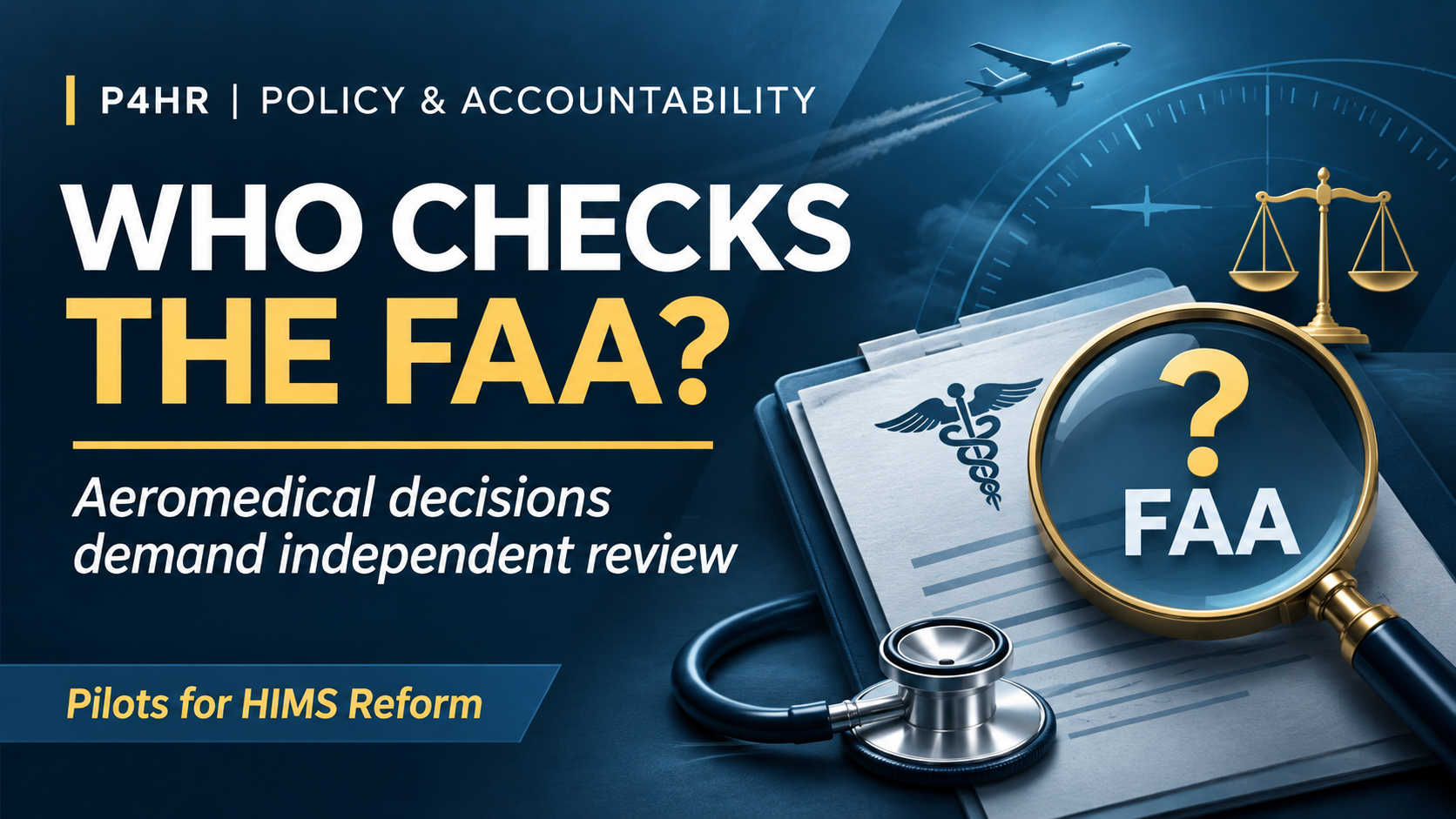
The FAA Demands Proof of Fitness From Pilots. Who Holds Its Aeromedical Decision-Makers Accountable?
Pilots must demonstrate medical fitness under standards that can determine whether they keep their livelihoods. It is reasonable to ask what comparable, independent standards govern the people who decide their fate.
A recent public discussion among aviators raised an uncomfortable question: if the Federal Aviation Administration's Office of Aerospace Medicine judges pilots' physical and mental fitness, what independent measures establish the fitness, competence, and impartiality of the officials making those decisions?
That is a legitimate public-policy question. It deserves something more serious than a reflexive defense of the agency—or an accusation that individual FAA doctors must somehow be impaired because they hold positions of authority.
Pilots for HIMS Reform (P4HR) believes the issue is structural: medical-certification power must be accompanied by transparent qualifications, professional accountability, evidence-based decision-making, and meaningful independent review.
Who Holds the Power to Say a Pilot Cannot Fly?
Under 14 C.F.R. § 67.407, federal medical-certification authority is delegated to the Federal Air Surgeon and, subject to regulatory limits, to other authorized FAA officials and aviation medical examiners. Those powers include the issuance and denial of medical certificates and decisions affecting Special Issuance authorizations.
For a pilot in the Human Intervention Motivation Study (HIMS) system, a decision can mean continued testing, repeated psychiatric or psychological assessment, monitoring conditions, delays in progression, or an uncertain path toward unrestricted certification. Not every adverse decision is incorrect. But every consequential decision should rest on an identifiable standard and a defensible assessment of current risk.
14 C.F.R. § 67.401 gives the Federal Air Surgeon substantial discretion in Special Issuance matters. It also specifies certain procedures, including written reasons and review rights when an existing authorization is withdrawn. This is not a system with literally no process; the question is whether its processes are sufficient when discretionary decisions remain disputed, poorly explained, or difficult for an airman to challenge on the merits.
Should FAA Aeromedical Doctors Hold First-Class Medical Certificates?
One proposal in the public discussion was to require AAM management physicians to hold a valid first-class airman medical certificate themselves. Its appeal is understandable: leaders charged with assessing pilot fitness should not appear insulated from independent standards.
There is, however, an important legal and medical distinction. 14 C.F.R. § 61.23 and the FAA's own guidance tie classes of pilot medical certificates to flying privileges. A first-class certificate is not a general license to practice medicine, nor is it a validated measure of an agency physician's ability to interpret medical evidence or adjudicate a complex HIMS file.
Making a first-class pilot medical a universal employment requirement for nonflying physicians could exclude otherwise qualified doctors without necessarily producing better aeromedical decisions. That is why P4HR favors a more precise requirement: independent, role-appropriate fitness-for-duty standards, verified professional credentials, continuing clinical competence, ethics safeguards, and periodic quality review.
What About Drug and Alcohol Testing for FAA Aeromedical Officials?
Here, too, careful distinctions matter. 14 C.F.R. § 120.105 and § 120.215 enumerate the safety-sensitive aviation functions covered by their industry drug- and alcohol-testing provisions, such as flightcrew, maintenance, dispatch, and air traffic control duties. Serving as an FAA aeromedical physician is not, by itself, a separately listed Part 120 function.
But that does not establish that AAM physicians are exempt from every federal drug-testing obligation. Federal employees may be subject to other drug-free-workplace rules, including testing-designated-position classifications. For example, the Department of Transportation's 2010 Drug and Alcohol-Free Departmental Workplace Program order (3910.1D) distinguished testing-designated positions from other federal jobs and described different testing circumstances. Because that order is dated and individual current AAM position classifications have not been verified here, it would be irresponsible to claim that all AAM managers are routinely tested—or that none are.
It would be equally irresponsible to suggest that FAA physicians have a high prevalence of substance-use disorders without supporting evidence. P4HR is making no allegation about any identified physician's medical condition, sobriety, or fitness.
Our request is narrower, and stronger: the FAA and DOT should disclose the current, nonpersonal rules and position classifications governing appropriate fitness-for-duty assessment, drug testing, alcohol testing, and professional oversight for aeromedical decision-making personnel. If a role is excluded, the agency should be able to explain why that classification is suitable for the role's responsibilities.
Physical Fitness Alone Will Not Fix an Accountability Problem
A physician can be in excellent physical health and still make an unsound medical decision. A physician can also live with a managed medical condition and perform exceptionally well. The point of independent oversight is not to stigmatize doctors; it is to assess the quality and integrity of the work.
For the pilots P4HR represents, the deeper concern is what happens when current testing, expert assessments, clinical records, and documented recovery appear to support a favorable outcome, yet the agency reaches a different conclusion without sufficiently identifying the disqualifying evidence or explaining what the airman must do to satisfy the standard.
Medicine necessarily involves judgment. But judgment should not mean unbounded discretion. It should mean applying transparent criteria to the evidence, documenting why competing evidence was accepted or rejected, and allowing the conclusion to be independently evaluated.
What standard did the FAA apply? What objective evidence supports the decision? What evidence was discounted—and why? What, precisely, would change the outcome? And who outside the original chain of decision-making can review the answer?
Five Practical Reforms Worth Pursuing Now
- 1. Independent clinical review. Provide a meaningful, conflict-screened second opinion in disputed medical-certification and HIMS progression decisions, with reviewers qualified in the relevant specialty and not beholden to the original decision-maker.
- 2. Written, evidence-specific explanations. Identify the controlling medical standard, material evidence, reasons for rejecting contrary expert findings, and measurable conditions for a different outcome, while preserving legitimate privacy and security protections.
- 3. Credentials, continuing education, and quality audits. Publish the professional qualifications expected of aeromedical adjudicators, require current training in relevant clinical and recovery science, and audit decision consistency and error correction.
- 4. Transparent, role-appropriate employee safeguards. Explain which aeromedical positions are testing-designated, what fitness-for-duty policies apply, how conflicts of interest are handled, and what independent mechanisms exist for reporting possible impairment or misconduct.
- 5. Measurable external accountability. Report aggregate turnaround times, reversals, remands, monitoring-extension outcomes, and complaint resolution data; establish credible independent oversight rather than relying solely on review inside the same hierarchy.
Why This Is Part of P4HR's Larger Reform Campaign
P4HR's 2026 petition for FAA rulemaking, Docket FAA-2026-10399, and subsequent petition for reconsideration have pressed for objective standards, clearer monitoring endpoints, written reasons, fair timelines, and meaningful independent medical review. The proposed P4HR Act likewise seeks stronger enforceable due-process protections.
These requests do not lower the bar for aviation safety. They raise the bar for government decision-making. An agency that demands rigorous evidence from a pilot should welcome rigorous examination of the process by which it evaluates that evidence.
Independent oversight also protects conscientious FAA physicians. Transparent standards and defensible peer review reduce the risk that decisions are distorted by inconsistent practices, inappropriate outside influence, or personal conflicts.
A Direct Challenge to the FAA and Congress
We invite FAA aeromedical leadership, DOT officials, congressional oversight committees, and other aviation stakeholders to answer several straightforward questions: What qualifications and continuing-competency requirements apply to AAM medical adjudicators? Which positions are subject to current federal testing and fitness-for-duty safeguards? How are conflicts of interest documented? What objective criteria are used to review HIMS progression or termination of monitoring? And what independent body can correct a medically unsupported decision without requiring an airman to endure years of uncertainty?
Those are legitimate questions about public administration. They do not depend on proving anything about the private health of an individual FAA employee.
P4HR will continue to seek those answers and to advocate for a system that protects both the traveling public and the constitutional and procedural rights of the airmen who serve it. Safety and due process are not competing interests. A credible aviation medical system must deliver both.
- 14 C.F.R. § 67.407 — Delegation of medical-certification authority
- 14 C.F.R. § 67.401 — Special Issuance, discretion, and withdrawal procedures
- 14 C.F.R. § 61.23 — Pilot medical certificate requirements
- 14 C.F.R. § 120.105 — Drug-testing-covered aviation functions and § 120.215 — Alcohol-testing-covered functions
- DOT Order 3910.1D (2010) — Federal employee drug- and alcohol-free workplace program (historical policy document; current position-specific coverage requires verification)
- P4HR rulemaking docket FAA-2026-10399
Editorial note: This is a policy analysis and call for transparency. It makes no finding of medical impairment, substance misuse, or professional misconduct by any individual FAA physician.
Read the reform docket, share your documented experience, and support independent advocacy for pilots.
Contact P4HRSupport the Mission