
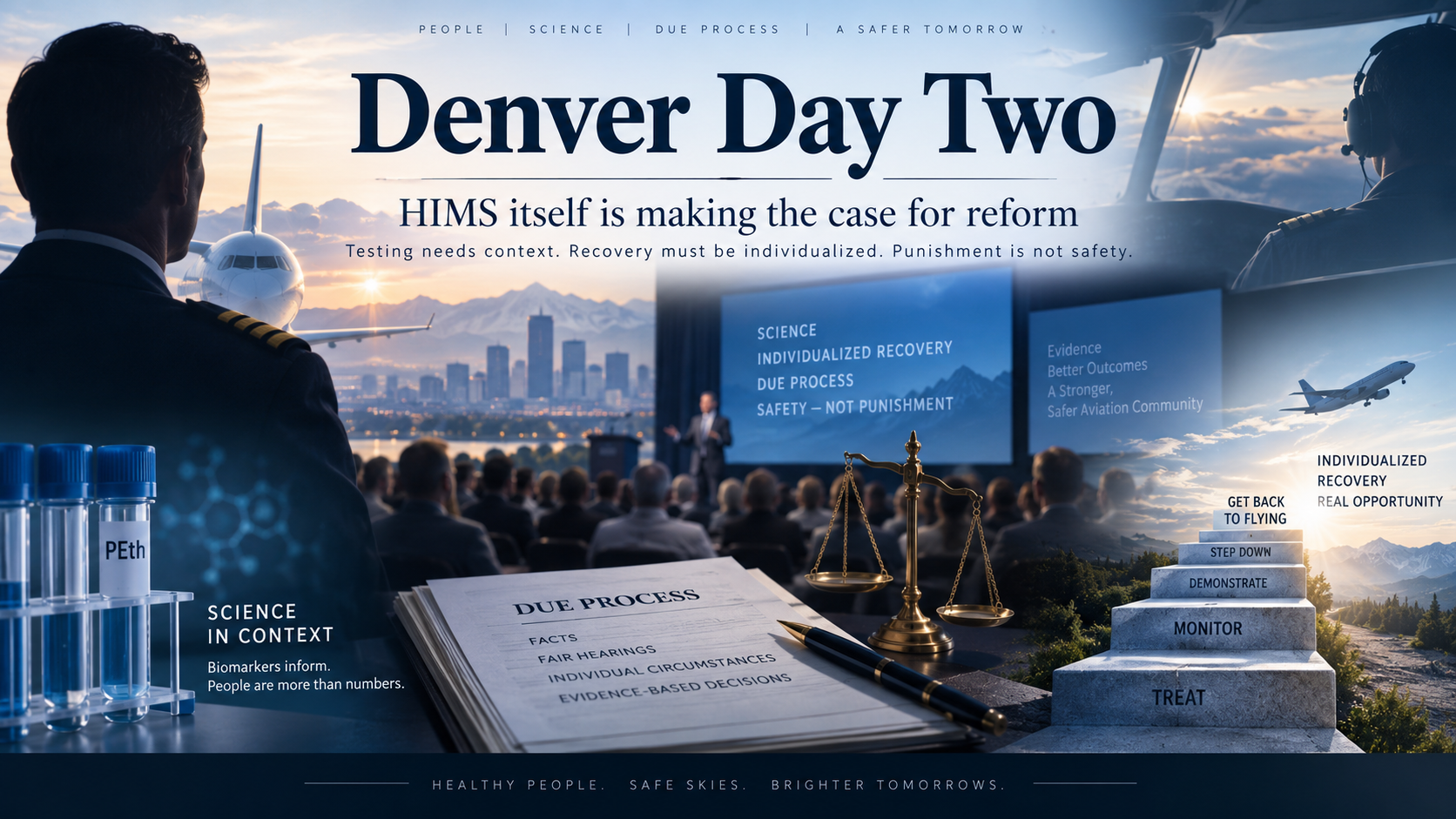
Denver Day Two: HIMS Itself Is Making the Case for Reform
From PEth testing and peer monitoring to relapse, certificate revocation, neuropsychology and the general aviation gap, Day Two of the 2026 HIMS Seminar revealed something important: many of the strongest arguments for HIMS reform are now being voiced from inside the HIMS community itself.
DENVER — Day Two of the 2026 HIMS Seminar may prove to be one of the most consequential days of the conference for Pilots for HIMS Reform—not because anyone stood on stage and declared HIMS fundamentally broken, but because the presentations repeatedly acknowledged where the system can work better. Speakers described lives saved, careers restored, families rebuilt and pilots successfully returned to the flight deck through treatment and recovery. P4HR does not dispute those successes.
What made the day important was the degree of common ground that emerged across discussions of drug and alcohol testing, recovery programs, treatment, peer monitoring, relapse, neuropsychological evaluation, airline policies and general aviation. Again and again, the themes sounded familiar: individualized medicine, better science, objective evidence, less punitive policy, more transparency, greater consistency and meaningful safeguards when the system gets something wrong. That is reform.
DOT Testing and HIMS Monitoring Are Not the Same Thing
One of the day’s earliest presentations carefully distinguished federally mandated DOT drug and alcohol testing from abstinence testing required under an FAA Special Issuance. DOT testing operates under detailed federal procedures governing collection, chain of custody, Medical Review Officer review, confirmatory testing, split specimens and defined return-to-duty and follow-up procedures. HIMS Special Issuance testing operates differently, with phased FAA monitoring requirements and significant professional discretion depending on an individual’s recovery and circumstances.
That distinction raises a basic question for any evidence-based monitoring system:
How much monitoring is enough—and what objective evidence determines when additional monitoring no longer improves aviation safety?
A modern medical system should be able to answer both parts of that question.
PEth: Powerful Tool, Unsettled Standards
Perhaps the most notable testing statement of the day came during the discussion of phosphatidylethanol, or PEth. In response to an audience question, the presentation acknowledged that “there are not uniform PEth standards.” That deserves the aviation community’s attention because PEth has become an enormously consequential biomarker in alcohol monitoring.
The session also highlighted the limits of treating any laboratory result as self-explanatory. Different tests have different detection windows; EtG and EtS do not measure the same period as PEth; whole-blood and dried-blood-spot testing involve different collection considerations; and testing can raise questions involving thresholds, specimen handling and screening limitations. The presentation also emphasized that a negative result does not necessarily establish abstinence if use falls outside a test’s detection window or below its reporting threshold.
That scientific caution should work both ways. A laboratory result is evidence, not a substitute for clinical judgment. Where a single test can profoundly affect a pilot’s career, P4HR believes the standards governing that test should be transparent, uniform and scientifically defensible. We will have considerably more to say about PEth after Denver.
Monitoring Reports Should Be Facts, Not Suspicion
Another presentation focused on one of the less visible but highly consequential parts of HIMS: peer and management monitoring letters. The guidance was direct. Monitors were told to report facts and observations—not rumors, speculation or personality judgments—and one instruction stood out:
Write the report as though you may someday have to defend it in court.
That principle matters because a monitoring letter can become part of the information used to determine whether a pilot remains medically qualified. If information is consequential enough to affect a federal medical determination, a certificate, a livelihood and a career, it should be accurate, relevant and capable of surviving scrutiny. That is due process.
The presentation also offered examples of what should not appear in a monitoring report: unsupported assertions that someone is using drugs, personal attacks, demands to test broadly simply to “see what sticks,” or conclusions unsupported by actual observations. Those safeguards should not merely be good advice; they should be foundational principles throughout aeromedical certification.
An Extraordinary Admission: Some Pilots Do Not Belong in HIMS
During the pilot and management breakout, another important point surfaced: there are individuals in HIMS who simply should not be there. The message was straightforward. If someone does not actually have the substance-use disorder HIMS is designed to address, it is neither appropriate nor fair to keep that person in the program.
That may be one of the most important areas of common ground emerging from Denver, but it immediately raises the harder question:
What happens when the system gets it wrong?
What happens when later evidence undermines the original diagnosis, when independent specialists produce favorable findings, or when years of objective data no longer support the level of oversight being imposed? HIMS has developed sophisticated pathways for bringing people into monitoring. A modernized system needs an equally credible off-ramp when continued participation can no longer be medically justified.
Recovery Is Not One Size Fits All
Day Two also included an extensive discussion of peer recovery programs. Alcoholics Anonymous and Birds of a Feather remain deeply embedded in HIMS culture, but speakers also discussed SMART Recovery, Recovery Dharma, secular recovery programs and other alternatives. The central message was not that every pilot must recover in the same way; it was that recovery is the objective.
Pilots differ in their beliefs, experiences, families and needs. The program that works extraordinarily well for one person may not resonate with another. What matters is whether the individual develops genuine, sustainable recovery. If HIMS can recognize multiple legitimate pathways to recovery, aviation medicine should also recognize that the appropriate duration, intensity and structure of monitoring may differ between individuals. Individualized recovery should eventually lead to individualized certification.
Relapse: Disease or Punishment?
The seminar’s discussion of relapse was equally revealing. One speaker described addiction as a chronic condition involving periods of remission and, in some cases, relapse. The focus was on understanding what happened, identifying underlying contributors and helping the individual return to meaningful recovery. Shame, stigma and punitive responses were identified as barriers.
One presenter compared aviation’s response to substance-use relapse with the management of other chronic medical conditions. The larger question was obvious:
If we say addiction is a disease, are our policies actually treating it like one?
Recognizing substance-use disorder as a medical condition does not require ignoring aviation safety. The opposite is true. A strong safety system should encourage pilots experiencing difficulty to come forward early, before a problem becomes a catastrophe. Policies that make pilots terrified of seeking help can undermine that objective.
Punishment Is Not Automatically Safety
The pilot-management breakout pushed that issue further. Twenty-three airlines reportedly participated in an informal comparison of HIMS-related policies, and the differences were significant. Some airlines pay treatment and evaluation expenses while others do not. Education, disability benefits, relapse policies and DOT-positive employment policies vary widely.
One inconsistency was particularly striking: some airlines may terminate their own pilot following a DOT-positive test while later hiring a successfully recovered pilot who experienced a DOT positive somewhere else. The discussion then turned to FAA certificate enforcement and whether revoking certificates and type ratings provides a meaningful aviation-safety benefit when the pilot is already unable to exercise those privileges.
A consequence can be severe without making aviation safer.
If a policy exists primarily as punishment, policymakers should be willing to say so. If the justification is safety, there should be evidence showing how the policy improves safety. Those are different rationales, and aviation regulation should always be capable of answering the question: What safety outcome does this requirement actually produce?
Neuropsychology: A Test Should Not Be a Coffin Nail
The neuropsychology breakout offered one of the day’s more encouraging messages. Pilots often approach FAA-directed neuropsychological testing terrified that one poor performance will end their career. The neuropsychologists speaking at the seminar pushed hard against that perception, describing these evaluations as clinical tools that must be interpreted in context.
Anxiety, developmental history, learning differences, past substance exposure, educational functioning and actual professional performance all matter. If something unexpected appears, the proper question is not simply whether the pilot “passed” or “failed,” but why the result occurred, whether it conflicts with the broader record and whether additional information resolves the concern.
One neuropsychologist emphasized that an unfavorable result on a particular day should not be understood as the pilot having the proverbial coffin nailed shut. There should still be a pathway forward. That philosophy is exactly what evidence-based aeromedical certification should look like: investigate, understand, individualize, then decide.
The General Aviation Gap Is Real
One of the day’s strongest presentations focused on general aviation and non-airline pilots. The difference between the airline HIMS experience and the GA experience can be enormous. An airline pilot may have access to a union HIMS chair, peer monitors, management pilots, company-funded treatment, disability protection and experienced professionals who understand how to navigate FAA requirements. A general aviation pilot may have none of those things.
The presenter described entering the FAA medical process largely alone and spending years attempting to navigate a system that airline pilots frequently experience with an entire support network around them. That disparity matters. Medical standards do not become less consequential because someone flies general aviation, nor should access to a fair and understandable certification pathway depend upon which airline employs the applicant. Any serious reform effort must recognize the much larger aviation community affected by FAA medical certification.
Treatment Itself Deserves Scrutiny
Another presentation offered an unusually practical discussion about choosing treatment programs. Not every facility is the same, and not every program understands aviation. Insurance authorization may conflict with the duration or type of treatment professionals believe a pilot needs; “accepts insurance” does not necessarily mean “in network”; ancillary costs can become significant; and discharge planning, family support, clinical staffing and timely documentation can all affect the recovery and certification process.
There was also discussion of situations in which aviation professionals attempted to influence treatment-facility diagnoses using aviation standards rather than allowing clinicians to make diagnoses based on their own professional criteria. That should concern everyone. Clinical diagnosis and federal certification are related, but they are not interchangeable. A treatment professional should diagnose the patient; the FAA should determine certification. Blurring those roles creates substantial potential for error.
The Theme We Keep Hearing: Quality Over Box Checking
Perhaps the most consistent theme throughout Day Two was that good recovery cannot be reduced to checking boxes. Going to a meeting does not necessarily prove recovery. Passing a test does not necessarily prove abstinence. Missing a meeting once does not automatically prove instability. A disagreement at work does not automatically prove relapse, and a neuropsychological weakness does not automatically prove impairment.
Speaker after speaker emphasized context, quality, relationships, patterns, clinical judgment and observable facts. That matters because bureaucracies naturally move toward checklists, thresholds, categories, mandatory requirements and fixed schedules. Those tools may be easy to administer, but people are not checklists, and medicine cannot become more scientific by becoming less individualized.
This Is What Reform Looks Like
P4HR came to Denver because we believe strongly in aviation safety. We also believe the HIMS program has helped many pilots recover and return to productive careers. Those things can be true while another thing is also true: the program can be improved.
Day Two demonstrated how much common ground already exists. We heard that monitoring reports should be factual and defensible, that recovery pathways can be individualized, that some pilots do not belong in HIMS, that PEth practices are not uniform, that punitive policies deserve scrutiny when they do not clearly improve safety, that relapse should be approached clinically rather than through stigma, that general aviation remains underserved, and that neuropsychological evaluation should identify pathways rather than function as automatic failure.
None of those ideas undermine HIMS. They point toward what the next generation of HIMS should become.
The reform conversation is no longer happening only outside the room. Increasingly, we are hearing pieces of it from inside the room as well. That may be the most encouraging development of the entire seminar.
This is P4HR’s Day Two report from the 2026 HIMS Seminar in Denver. In the coming days, we will take deeper looks at several issues raised during today’s sessions, including PEth standardization, punitive certificate enforcement, procedural safeguards in monitoring reports, and the need for a meaningful pathway out of HIMS when continued monitoring is no longer scientifically justified.
About P4HR: Pilots for HIMS Reform is an independent pilot advocacy organization seeking transparent, evidence-based, time-limited, and safety-focused reform of FAA HIMS medical certification and monitoring practices. P4HR is not affiliated with the FAA or the official HIMS Program.